Election night in the United States brought us interactive websites, holographic interviews, and more data than any one person could possibly digest. None-the-less, there are a few lessons educators can learn from the news event of the decade.
Words and how they are delivered are powerful agents of change.
In the end, the most powerful part of the evening was simple... a man, a message, and the coming together of people from around the world.
Interactivity can and should be used to engage your audience.
This was the first US Election in the age of YouTube, whose Video Your Vote channel garnered attention from across the United States.
While John King is the master of the Multi-touch Collaboration Wall,the Associated Press map and the National Public Radio map let participants create their own scenarios and to drill down through state and county statistics.
The technology is only the means to an end.
Holograms are 'cool' but the wow factor fades quickly. While Obama's words are sure to live on for decades, the gaudy technologies used by broadcasters to connect with viewers, will soon be forgotten.
Eye candy can be used to tell a story, but don't let the technology fool you into believing it's any bit as important as the real story. Wasn't the story of the presidential election compelling enough? In case you missed it, apparently CNN's holograms were really tomograms.
Wednesday, November 5, 2008

Sunday, November 2, 2008
Top Ten Types of Tweets
While Twitter is fast becoming a recognized way to communicate with friends, acquaintances, and professional peers, those new to micro-blogging often find themselves communicating in a limited number of ways. It's not just about mining your feeds for resources, it's about building relationships with your tweet-mates. The best way to do that, is to make an effort to post a variety tweets.

Do the Play-by-Play: Broadcast a live concert or sports event; or share your response to a popular televised experience. Twitter is about community, and the sharing of your live responses can make any news report, playoff game, or special event a memorable group experience.
Be a Friend: Send supportive replies to the tweets of your colleagues. If you can answer a question, lend your insight. If you'd like to keep your conversation private, don't be shy about sending direct messages. With practice, you'll soon deepen your online relationships.
Let the Twittersphere attend your Presentations: If you are attending a conference, or presenting a workshop, consider streaming or live-blogging the event. Tools like UStream.tv and Cover-it-Live make it possible to share text, audio and video, and to do so at no cost. Tweet the links and use conference hashtags to assist those looking for updates.
Publicize your Learning Ventures: Tell us about your online publications be they blog posts, podcasts or wiki projects. Using Twitter exclusively for self-promotion isn't recommended, but doing so as part of a broad range of tweets can help your followers understand your work 'in context'.
Re-Tweet: Share the best links and stories that come down your Twitter stream. It's great to be re-tweeted, so don't be shy about quoting the people you follow. At their best, re-tweets often serve to introduce your followers to colleagues who can enrich their personal learning networks.
Report the News & the Weather: Have you noticed the number of news broadcasts that are beginning to reference Twitter? Whether you're experiencing threatening weather or are present for a newsworthy event, you can be the first on the scene reporter. Tell your network what's going on, and encourage them to share the story with others.
Tweet the Small Stuff: Let us know you're a real person, by sharing occasional tidibits from your daily life. Share the cute stuff, the aching frustrations, the mini-revelations... In doing so, we remind ourselves and our followers how much we treasure experiences in the real world; and we remind colleagues and friends that family and community play important roles in our lives.
Ask for Help: Don't be shy. If you've built a network of followers, rely on the expertise around you! Need a resource or want feedback on an idea? Feel free to post the occasional question. Over time, you'll be surprised at the range of support you will receive.
Get Your Tribe Together: With Twitter apps appearing on more and more mobile devices, Twitter is the perfect vehicle for organizing impromptu gatherings among colleagues. Whether meeting at a restaurant, movie theatre, or online meeting space, the tweeting of meet-up details is fast becoming a popular mechanism for bringing people together.
Be Playful: Posting an occasional puzzle, riddle, or challenge is a good way to encourage creative thinking on your network. As Twitter groups become more popular, I think we'll soon see gameshows appear on the Twitter network.
Having a diverse network of followers and followees makes for the richest Twitter experience. Emulating this variety in your own posts will help you to be seen as a valuable and personable node in the network.
The Common Craft explanation of Twitter can help you introduce the idea to colleagues. Are there other types of Twitter posts that catch your attention? Are there any types of post that you'd recommend we NOT try to emulate?

Do the Play-by-Play: Broadcast a live concert or sports event; or share your response to a popular televised experience. Twitter is about community, and the sharing of your live responses can make any news report, playoff game, or special event a memorable group experience.
Be a Friend: Send supportive replies to the tweets of your colleagues. If you can answer a question, lend your insight. If you'd like to keep your conversation private, don't be shy about sending direct messages. With practice, you'll soon deepen your online relationships.
Let the Twittersphere attend your Presentations: If you are attending a conference, or presenting a workshop, consider streaming or live-blogging the event. Tools like UStream.tv and Cover-it-Live make it possible to share text, audio and video, and to do so at no cost. Tweet the links and use conference hashtags to assist those looking for updates.
Publicize your Learning Ventures: Tell us about your online publications be they blog posts, podcasts or wiki projects. Using Twitter exclusively for self-promotion isn't recommended, but doing so as part of a broad range of tweets can help your followers understand your work 'in context'.
Re-Tweet: Share the best links and stories that come down your Twitter stream. It's great to be re-tweeted, so don't be shy about quoting the people you follow. At their best, re-tweets often serve to introduce your followers to colleagues who can enrich their personal learning networks.
Report the News & the Weather: Have you noticed the number of news broadcasts that are beginning to reference Twitter? Whether you're experiencing threatening weather or are present for a newsworthy event, you can be the first on the scene reporter. Tell your network what's going on, and encourage them to share the story with others.
Tweet the Small Stuff: Let us know you're a real person, by sharing occasional tidibits from your daily life. Share the cute stuff, the aching frustrations, the mini-revelations... In doing so, we remind ourselves and our followers how much we treasure experiences in the real world; and we remind colleagues and friends that family and community play important roles in our lives.
Ask for Help: Don't be shy. If you've built a network of followers, rely on the expertise around you! Need a resource or want feedback on an idea? Feel free to post the occasional question. Over time, you'll be surprised at the range of support you will receive.
Get Your Tribe Together: With Twitter apps appearing on more and more mobile devices, Twitter is the perfect vehicle for organizing impromptu gatherings among colleagues. Whether meeting at a restaurant, movie theatre, or online meeting space, the tweeting of meet-up details is fast becoming a popular mechanism for bringing people together.
Be Playful: Posting an occasional puzzle, riddle, or challenge is a good way to encourage creative thinking on your network. As Twitter groups become more popular, I think we'll soon see gameshows appear on the Twitter network.
Having a diverse network of followers and followees makes for the richest Twitter experience. Emulating this variety in your own posts will help you to be seen as a valuable and personable node in the network.
The Common Craft explanation of Twitter can help you introduce the idea to colleagues. Are there other types of Twitter posts that catch your attention? Are there any types of post that you'd recommend we NOT try to emulate?
Saturday, November 1, 2008
Post-Modern Digital Story-Telling
Although ASCII characters and emoticons are 'old school', using them to tell a story adds an entertaining, and challenging new twist.
Wednesday, October 29, 2008
The Classrooms of the Future are Already Here
I don't relish long car rides, but they are a fact of life in my current teaching position. As an educator working to assist school boards in leveraging a variety of e-learning tools, I often find myself in my car, many kilometers from home. With podcasts and audio books to keep my mind humming, I'm able to engage in conversations inside my head, with authors and independent broadcasters from around the world.
 My most recent brain food, was Seth Godin's nutrient-packed "Tribes: We Need You to Lead" which fit perfectly in a recent two way trip to the extreme southwest part of Ontario. The book is very much an invitation to listeners to stop waiting and to start leading.
While anyone's tribe can be characterized as a group of like-minded people, getting these similarly motivated individuals to pull in a common direction, can be a challenging task.
 Grab onto the rope...
The toughest test facing educators passionate for change, is to envision the schools we'd like our children to attend.
The classrooms of the future already exist! It's just that they're widely scattered and remain unknown to the majority.
In order to publicize what's happening through the daily efforts of highly engaged educators like you, I'm making plans to tell your stories. If you have ever thought "I should just start my own school", you probably have at least one story to contribute to our tribe's vision for the future of education.
While each of us has a limited sphere of influence, the sharing of our stories cannot help but lead others to envision what is possible. My hope is that classrooms like yours will become the norm, rather than the exception, but for that to happen, your story must be told.
Our tribe's first story, "Going Mobile!" tells the story of how cell phones have been leveraged for learning on an Australian field trip. I hope that your story will follow...
Photo Credit: Dan Maudsley
 My most recent brain food, was Seth Godin's nutrient-packed "Tribes: We Need You to Lead" which fit perfectly in a recent two way trip to the extreme southwest part of Ontario. The book is very much an invitation to listeners to stop waiting and to start leading.
 While anyone's tribe can be characterized as a group of like-minded people, getting these similarly motivated individuals to pull in a common direction, can be a challenging task.
 Grab onto the rope...
 The toughest test facing educators passionate for change, is to envision the schools we'd like our children to attend.
The classrooms of the future already exist! It's just that they're widely scattered and remain unknown to the majority.
In order to publicize what's happening through the daily efforts of highly engaged educators like you, I'm making plans to tell your stories. If you have ever thought "I should just start my own school", you probably have at least one story to contribute to our tribe's vision for the future of education.
While each of us has a limited sphere of influence, the sharing of our stories cannot help but lead others to envision what is possible. My hope is that classrooms like yours will become the norm, rather than the exception, but for that to happen, your story must be told.
Our tribe's first story, "Going Mobile!" tells the story of how cell phones have been leveraged for learning on an Australian field trip. I hope that your story will follow...
Photo Credit: Dan Maudsley
Sunday, October 26, 2008
Halloween Treats (and one Trick)

I thought I'd take a few minutes to share a few links for a hauntingly fun week.
Pumpkinizer: Change a photo into a detailed jack-o-lantern
Virtual Pumpkin Carver: Practice your pumpkin carving with this no mess interactive Flash-based tool.
PumpkinGutter: The gallery of 3D carvings is incredible.
Extreme Pumpkins: Many unique pumpkin carving ideas are shared on this site.
Christopher Walken Mask: Instead of "Trick or Treat" just demand "I Need More Cowbell"!
Scary Stories: There is still a few cool and windy late October evenings to do some reading...
The Real Story of Halloween: Among a number of highlights on this site is Hidden Spirits an interactive role playing game.
The Ghost and Mr. Chicken: Of all the movies I own, this has to be my favourite! If you're lucky enough to find it, this is the perfect week to watch it. If you can't find this one, The Nightmare Before Christmas is another Halloween gem.
Those with a strong constitution may be interested in a ghost story that is too disturbing for me to include in this space. After watching Nicolas Cage briefly describe his ownership of the Lalaurie Mansion of New Orleans, I unwittingly came across one of the most deeply disturbing stories I've ever read.
If you take the time to find the story that David Letterman was wise enough NOT to pursue... know that I share your regrets.
Happy Halloween!
Photo Credit: Paul Sapiano
Thursday, October 23, 2008
Let's Teach Them to Cheat!
Earlier this week, I had a rare opportunity to have lunch with my identical twin brother. Even though we've taken different paths in our lives, we've each managed to make use of the tools of the evolving web in order to connect with colleagues.
 With this common interest, it's no surprise that our conversation consistently returns to the use of the Internet, and a wide range of teaching and learning applications. While waiting for our meals to arrive at our table, I suggested that traditional tests might be rendered useful, if we were to teach students how to cheat in completing them.
While it may sound radical to encourage cheating, students today have grown up in a culture that generally accepts a variety of unsavoury behaviours:
* finding and sharing 'cheat' codes for video games;
* bypassing digital rights management on CD and DVD media;
* using proxy servers to access filtered/blocked/banned web content;
* downloading applications from the web and using 'cracks' to gain access;
* accessing private networks, whether open or password protected;
* cracking digital devices to expand their functionality beyond licensing agreements;
* creating unique works by appropriating the unlicensed photographic or musical expertise of others;
 It's no secret that I am on unfriendly terms with the traditional test, so if I had to give students a test today, I think I'd challenge them to respond with limited restrictions. I might allow them to talk to one another; to copy from one another; or to access the internet or outside experts.
What skills might students develop in sanctioned cheating?
In a group or class test:
In copying content from other students, each learner would have to apply critical thinking skills in validating responses. If a class or group had to submit one complete test for the entire group, you'd really be able to assess the collaborative skills possessed by a group or sub-groups. Without a doubt, an observant teacher would be able to see which students had the greatest sharable 'capital', and which had the most effective leadership skills.
In an open book test:
Students would have to condense material into it's most important elements, and would have to organize their resources so that appropriate content could be efficiently accessed.
In a test to design a cheating tool:
Students would highlight their varied abilities to innovate in creating unique uses for personal digital devices; or they might demonstrate their creativity in re-purposing common backpack or lunchbox objects.
In an open computer test:
Beyond exhibiting their search skills, students would be challenged to assess the validity of their sources. Another important skill might be embedded in this activity, were a teacher to require students to provide more than one reference for any test response.
In an open phone test:
Students might have to budget a limited number of text messages or phone-a-friend calls, meaning they'd have to assess their areas of greatest need. Could metacognition skills actually be testable?!
Here's your test question... Use any source you like, but in posting your response below, reference your source(s), and try to provide a level of confidence in your answer.
"How many different times have human beings been to the moon?"
C'mon, you can answer that one can't you? Go ahead and cheat if you like!
Photo Credit: Mr. Stein; Billaday
 With this common interest, it's no surprise that our conversation consistently returns to the use of the Internet, and a wide range of teaching and learning applications. While waiting for our meals to arrive at our table, I suggested that traditional tests might be rendered useful, if we were to teach students how to cheat in completing them.
While it may sound radical to encourage cheating, students today have grown up in a culture that generally accepts a variety of unsavoury behaviours:
* finding and sharing 'cheat' codes for video games;
* bypassing digital rights management on CD and DVD media;
* using proxy servers to access filtered/blocked/banned web content;
* downloading applications from the web and using 'cracks' to gain access;
* accessing private networks, whether open or password protected;
* cracking digital devices to expand their functionality beyond licensing agreements;
* creating unique works by appropriating the unlicensed photographic or musical expertise of others;
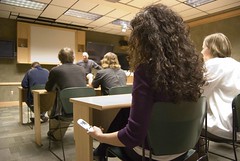 It's no secret that I am on unfriendly terms with the traditional test, so if I had to give students a test today, I think I'd challenge them to respond with limited restrictions. I might allow them to talk to one another; to copy from one another; or to access the internet or outside experts.
What skills might students develop in sanctioned cheating?
In a group or class test:
In copying content from other students, each learner would have to apply critical thinking skills in validating responses. If a class or group had to submit one complete test for the entire group, you'd really be able to assess the collaborative skills possessed by a group or sub-groups. Without a doubt, an observant teacher would be able to see which students had the greatest sharable 'capital', and which had the most effective leadership skills.
In an open book test:
Students would have to condense material into it's most important elements, and would have to organize their resources so that appropriate content could be efficiently accessed.
In a test to design a cheating tool:
Students would highlight their varied abilities to innovate in creating unique uses for personal digital devices; or they might demonstrate their creativity in re-purposing common backpack or lunchbox objects.
In an open computer test:
Beyond exhibiting their search skills, students would be challenged to assess the validity of their sources. Another important skill might be embedded in this activity, were a teacher to require students to provide more than one reference for any test response.
In an open phone test:
Students might have to budget a limited number of text messages or phone-a-friend calls, meaning they'd have to assess their areas of greatest need. Could metacognition skills actually be testable?!
Here's your test question... Use any source you like, but in posting your response below, reference your source(s), and try to provide a level of confidence in your answer.
"How many different times have human beings been to the moon?"
C'mon, you can answer that one can't you? Go ahead and cheat if you like!
Photo Credit: Mr. Stein; Billaday
Subscribe to:
Posts (Atom)