Showing posts with label lessons. Show all posts

Saturday, January 8, 2011

Lessons from the Rink

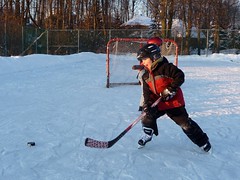
For the past 5 years, the Optimist Club of my community in Komoka, Ontario, has turned the community tennis courts into an all-season resource. During the winter, it becomes the Kilworth Colliseum. Recently, while out for a game of 'shinney', I found myself reflecting on a few lessons that are transferable to the networked learner.


Lesson #1...Just Play
When fully engaging, an activity can exist for the sake of the experience itself. Learning online, connecting with colleagues, discovering new tools... each of these can be an end in itself. For the sake of learning... just get out there and play!

Lesson #2...Wear a Helmet
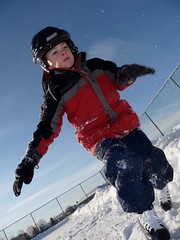
When you take learning to public space, you need to do so with caution. Consider how your actions may be perceived by others, and recognize that there may be dangers in sharing too much about yourself or your students. Be sure to take the right precautions before heading out onto the ice.

Lesson #3...Get Back Up
When you take risks; use modern learning tools; and lead with new learning strategies, inevitably, you're going to have lessons that don't quite turn out the way you expect. Regardless of the outcome, teacher-learners need to be resilient.

Lesson #4...Be Sure the Ice is Ready for Skating
When and idea, service, or initiative first comes to light, more often than not, it comes to us in its 'beta' form. Don't expect outstanding results, or a long term solution, if you venture out on such thin ice.

Lesson #5...Throw Your Stick in
The modern equivalent to choosing up sides, may be the co-development of personal learning networks. If you aren't invited to 'throw your stick in'; why not invite others to join you in discussing; learning; developing? Thanks to today's globally hyper-social Web, you can even 'throw your stick in' with people you've never met.

Lesson #6...Room for All
Whether skating on a rink, or learning to use modern learning tools, anyone can participate. Whether on the rink or in personal learning, it's up to the experienced skaters to create an environment that encourages the novices to keep coming out to play!

Lesson #7...Good Ice Takes Time (and Money)
There are a number of high quality apps that can help you and your students be more productive. Maybe it's time we realize that sometimes, it's worthwhile to pay a little bit for the best tools.

Lesson #8...Play to Improve
The more you play the better you get. It's true whether learning to skate, or creating a piece of media. And sometimes, it takes a bit of work, before you can truly see an experience as play.

Lesson #9...Come Outside
Perhaps the most important lesson of all, is that regardless of the season, there are times when we need to put aside our digital tools, and to embrace the wonders and experiences of the real world.
(This final photo is a late addition from Todd Lucier taken at Northern Edge Algonquin.)


The audio podcast episode that led to this post is now online; while my one minute documentary "If You Freeze it, They Will Come" is embedded below.

Thursday, October 9, 2008

All the Tech You Need to Know, You Learned in Kindergarten

The original book "All I Need to Know, I Learned in Kindergarten" was compiled by Robert Fulghum back when I began teaching in the late 1980's. Written to give life's lessons to adults, it was published before the World Wide Web even had a name. Taking time to reconsider Fulgham's ideas, his mini-essays are still quite relevant in the world of educational technology.

Share everything. License your work and then make it available to others. Share your passions, your ideas, your opinions, your work...

Play fair. Let others have a say, and let them contribute.

Don't hit people.
Spammers should read that one! C'mon, use your nicest voice even if you disagree with others.

Put things back where you found them. Well, how about telling others where you found things? Take time to share you bookmarks in Delicious or Diigo or another social bookmarking site. If you don't do that, at least send us a tweet when you find a gem.

Clean up your own mess.
Some might say "Read the ____ Manual"; I suggest trying to work yourself out of a jam before begging for assistance.

Don't take things that aren't yours. If you borrow or build on material produced by others, then attribute the original material.

Say you're sorry when you hurt somebody. If you err, admit your mistake and publish a correction, clarification, or retraction.

Wash your hands before you eat. And wash them after you eat; especially if you plan on using my keyboard!

Flush. Right, flush... your cache! Depending on your computer's settings, you might be holding on to gigabytes of unnecessary files. Who knows, your computer might just run a little more smoothly.

Warm cookies and cold milk are good for you.
Well, cookies do remind websites that you've visited before, and it helps them recognize you. Too many unsavoury cookies aare not good for you or your computer, so be sure that the cookies are the right kind.

Live a balanced life - learn some and think some and draw and paint and sing and dance and play and work every day some. Translation: Turn the computer off every once in a while! There is a world out there waiting for you!

When you go out in the world, watch out for traffic, hold hands and stick together. Collaborate with team members, colleagues and members of your wider network. If we engage evolving tools together, we're more likely to use them safely, productively and purposefully.

Be aware of wonder. Remember the little seed in the Styrofoam cup: the roots go down and the plant goes up and nobody really knows how or why, but we are all like that. We don't all have the answers; take pleasure in being a learner! The read/write web has plenty of magical finds to share, but we don't have to worry about knowing how or why everything is the way it is.

Goldfish and hamsters and white mice and even the little seed in the Styrofoam cup - they all die. So do we.
But your work on the world wide web will live on... make it worthy of near immortality.

And then remember the Dick-and-Jane books and the first word you learned - the biggest word of all - LOOK.
Take time to read the ideas of others. Use RSS to ensure that you have a regular diet of good things to LOOK at; and if you collect podcasts, to LISTEN to!

Monday, February 11, 2008

Stuck on Photos

I've been looking for a reason to share some ideas about the use of online photos in the classroom and although there are indeed educators making use of photography in their classrooms, few of them leverage the best of the free image resources of the day.

Why not help those creative writers by providing inspirational 'characters' to write about? Consider projecting some of these amazing 365 Portraits for starters.

Invite participation to categorize, sort and add meaning to once forgotten images in the Library of Congress Pilot Project.

Why not create a library of welcoming 'school/community guidebook' photos for families new to the community. Students can add explanatory audio notes via VoiceThread. Maybe you can even put those cell-phone cameras to use?

Highlight the power of photos when combined with words and music... easily worth more than 1000 Words.

How about teaching students to take advantage of terrific free public photos rather than ignoring fair use by grabbing the work of others that just happens to reside on the web. Free Digital Photos or BigFoto.com or FreeFoto.com are good starting points, but there are many others.

Consider teaching students that they can actually license their photos (and other creative works) for various uses vie Creative Commons licensing? For a generous example, some put their photos into the public domain a la Robert Scoble

Don't we owe it to students to point out how their world will be very different from ours? Showcase Photosynth in the video below, and ask students to contemplate the consequences: Are students being prepared for this future... for the jobs in such a world... for the yet-unwritten rules of the coming decades? Is it exciting, scary or both?


Review the dilemmas posed by those who 'sanitize' or 'satanize' with photo editing... Consider photo-ethics by consider sharing any of a number of Photo-Ethics resources.

Teach about Photo-editing via site resources like Luxa or teach the use of an online editor like Splashup. No doubt you'll want to share the often linked Dove commercial to expose some advertising secrets:


For those who may be interested, I maintain many more terrific links on my Delicious pages.