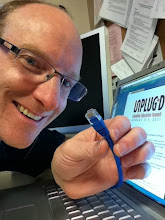
The first of many Tech 20 workshops took place today, and though the turnout was modest, attendees amounted to 10% of the staff at my school.
In 20 minutes, we managed to have teachers register with Animoto, and create short video presentations. Most satisfying, was the fact that so many of the attendees were novices in making use of technology. The example below was created by one such novice, the chaplain at our school:
I'm confident that word about this experience will spread. Guidance, math, language, social studies and chaplaincy were all represented, with teachers from special education and the humanities requesting rain checks.
I owe a big thank you to my PLN whose affirming comments and suggestions have helped to shape this initiative. Next up, I'll be whetting the appetite of my colleagues at a full staff meeting, by demonstrating Wordle as a literacy resource.
Tuesday, October 20, 2009

Friday, October 16, 2009
Tech 20 Tuesdays
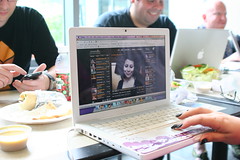 In order to provide support to teachers who wish to engage tech tools, I'm about to launch Tech 20 Tuesdays. In no more than 20 minutes, teacher-attendees will have a chance to learn about one tool or strategy that should make it easy to incorporate ICT into their classroom practice.
 My aim is to create a low stress; questions welcome; just come and explore environment that will promote greater use of a wide range of tools. Today's podcast, tells the story in more detail:
Are there any one-hit-wonders you'd recommend sharing with teachers in such a format?
Photo Credit: Tray
Thursday, October 15, 2009
Climate Change: Reflections from the Bus
As promised, I really am blogging from the bus. We're on the way to a volleyball tournament in Belleville, Ontario, and the team is resting after filling up on pizza. So why write now? And why further stress a computer with a cracked screen?
Sure, blogging from a bus is one way to demonstrate how technology can now be leveraged anytime, anyplace. And while I'm accessing the web through a tethered mobile phone, players are listening to ipods, watching DVD's, and playing games on portable devices.
But no one on this bus is thinking about arguably the most important issue facing the citizens of planet Earth.
Although the players and coaches on board do not realize that it is Blog Action Day, I'm compelled to reflect on the topic chosen for the day: Climate Change. With the Global Climate Summit slated for Copenhagen in a few short weeks, a more suitable topic would be difficult to find.
Even though I know of the power of words and images, I was still stunned in viewing the time lapse photography embedded in James Balog's Extreme Ice Loss presentation at TED. Witnessing the fracturing of glaciers during his extreme ice survey, the viewer can't help but conclude that "Climate Change is Real".
I'm not sure what you or your students have discovered about climate change, but it seems to me that there are few topics of greater importance for the future citizens of the world. Maybe you and your students will plan your own lesson for your community during next week's International Day of Climate Action?
Sure, blogging from a bus is one way to demonstrate how technology can now be leveraged anytime, anyplace. And while I'm accessing the web through a tethered mobile phone, players are listening to ipods, watching DVD's, and playing games on portable devices.
But no one on this bus is thinking about arguably the most important issue facing the citizens of planet Earth.
Although the players and coaches on board do not realize that it is Blog Action Day, I'm compelled to reflect on the topic chosen for the day: Climate Change. With the Global Climate Summit slated for Copenhagen in a few short weeks, a more suitable topic would be difficult to find.
Even though I know of the power of words and images, I was still stunned in viewing the time lapse photography embedded in James Balog's Extreme Ice Loss presentation at TED. Witnessing the fracturing of glaciers during his extreme ice survey, the viewer can't help but conclude that "Climate Change is Real".
I'm not sure what you or your students have discovered about climate change, but it seems to me that there are few topics of greater importance for the future citizens of the world. Maybe you and your students will plan your own lesson for your community during next week's International Day of Climate Action?
Monday, October 12, 2009
Imagining Conversations with Former Students
Have you ever bumped into former students and been surprised by what the students remember?
"Hey, I remember you! You taught me how to copy notes from the blackboard!"
"Remember when we did that algebra work, where we all filled in the spaces on that photocopy?!"
"Oh, and that time we read from the text book and answered the questions at the end of the section!"
In reality, these sample recollections are never celebrated. More commonly, the students with these memories are likely to pretend not to notice the teachers in question.
In preparing students for a future so difficult to predict, how is it that such activities still comprise a significant portion of a typical student's day?
The Classroom Matters
This weekend, I came across a The Fun Theory, a post at Mashable, that demonstrates how the environment significantly alters the way participants behave.
I look forward to the day when it will be the norm for classrooms to be arranged for discussion, rather than for teacher presentation. I anticipate the day when teachers regularly connect their learners with those in other classrooms; in other cities; and in other countries. I await the day when students can expect assessment of their learning to include performances that are beyond essays and exams.
If students walk into learning environments designed for interaction; with tools for meaningful collaboration; challenging future citizens to demonstrate their learning in engaging ways, then we will indeed be preparing our charges for a future of lifelong learning.
Though modern tools can be the catalyst to reforming our schools, significant changes to the classroom are beyond hardware & software. Whether or not we leverage emerging technologies, we can amplify the engagement of today's students by creating environments for interaction.
When you cross paths with your present students 10 years hence, how do you anticipate the conversation will begin?
"Hey, I remember you! You taught me how to copy notes from the blackboard!"
"Remember when we did that algebra work, where we all filled in the spaces on that photocopy?!"
"Oh, and that time we read from the text book and answered the questions at the end of the section!"
In reality, these sample recollections are never celebrated. More commonly, the students with these memories are likely to pretend not to notice the teachers in question.
In preparing students for a future so difficult to predict, how is it that such activities still comprise a significant portion of a typical student's day?
The Classroom Matters
This weekend, I came across a The Fun Theory, a post at Mashable, that demonstrates how the environment significantly alters the way participants behave.
I look forward to the day when it will be the norm for classrooms to be arranged for discussion, rather than for teacher presentation. I anticipate the day when teachers regularly connect their learners with those in other classrooms; in other cities; and in other countries. I await the day when students can expect assessment of their learning to include performances that are beyond essays and exams.
If students walk into learning environments designed for interaction; with tools for meaningful collaboration; challenging future citizens to demonstrate their learning in engaging ways, then we will indeed be preparing our charges for a future of lifelong learning.
Though modern tools can be the catalyst to reforming our schools, significant changes to the classroom are beyond hardware & software. Whether or not we leverage emerging technologies, we can amplify the engagement of today's students by creating environments for interaction.
When you cross paths with your present students 10 years hence, how do you anticipate the conversation will begin?
Monday, October 5, 2009
Taking Risks in Media Creation
 When I first began teaching in the late 1980's, I used to use video production as a tool to engage the creative minds of my students. At the time, the equipment was bulky, expensive, and difficult to access. Today in contrast, far more powerful tools for media creation and editing are available in the homes and on the desktops of our students.
 This brief podcast introduces a film production project that will put 'at risk' students into the roles of writer; director; properties manager; video-editor; producer; actor...
Do you know of an 'expert' in the field of professional media who can help us out by acting as a mentor and live 'Skype-in' guest?
Photo Credit: pt
Saturday, October 3, 2009
Google Wave on the Back-of-a-Napkin
The real challenge of today's World Wide Web, is to condense any idea into a nugget that can be digested by a diverse audience, in very short order. Rather than calling for a 5000 word essay as an explanation, the attention span of today's networked audience demands that that even the most complex idea be distilled into a back-of-the-napkin presentation.
Now that Google Wave is in limited release, this 2 minute explanation is rising the charts as the most efficient way to explain what may soon become E-mail 2.0.
Whether or not Google Wave changes the way we collaborate online, this presentation by Epipheo Studios, serves to remind teachers and students that there is a real art to explaining concepts for today's attention deficit world.
Now that Google Wave is in limited release, this 2 minute explanation is rising the charts as the most efficient way to explain what may soon become E-mail 2.0.
Whether or not Google Wave changes the way we collaborate online, this presentation by Epipheo Studios, serves to remind teachers and students that there is a real art to explaining concepts for today's attention deficit world.
Subscribe to:
Posts (Atom)