A few days ago, Ben Wilkoff posted From Network to Neighbourhood, a reflection on the cul-de-sacs of his personal/professional learning network. This morning I was walking when I received a message from Jabiz Raisdana who teaches on the other side of the planet. His note prompted me to take a minute to reflect on some of the more distant members of my PLN.
There are many, many other educators with whom I engage in public (and private) conversations on a regular basis. My neighbourhood/network was founded in late 2007 via Twitter, but has expanded many times since that time through a range of tools, experiences and events. If you're still trying to make sense of Twitter and the role it may play in your own PLN, Keri-Lee Beasley and Jabiz Raisdana have just published Twitter - A Cultural Guidebook. The book is based on Seven Degrees of Connectedness, and is available as a free download.
Showing posts with label PLN. Show all posts
Showing posts with label PLN. Show all posts
Sunday, January 27, 2013

Wednesday, January 23, 2013
Visualizing Connections
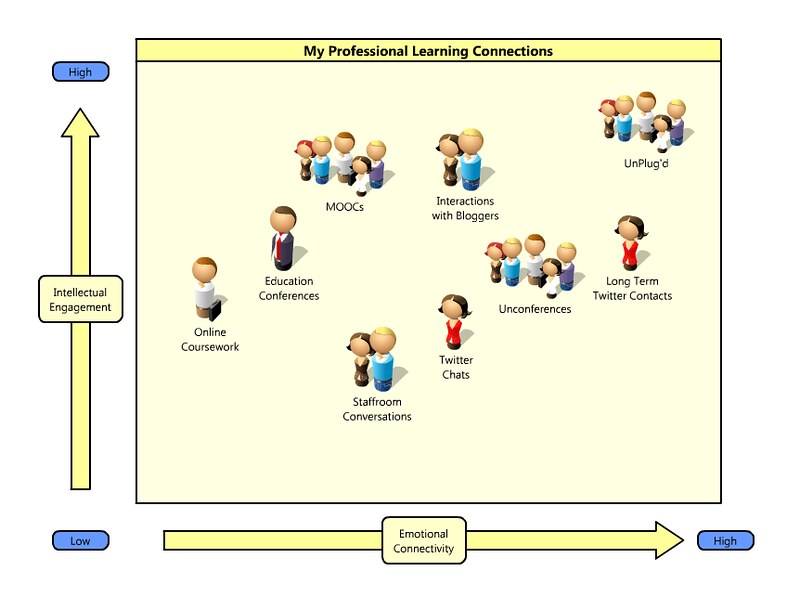
The relationships we build with other online learners will vary depending on the frequency of our connections and the nature of our sharing and collaboration. In this diagram, I've drawn on my personal experiences in specific learning environments, in an attempt to highlight the intellectual and emotional connections I've made with colleagues.
Although we don't often think about our professional relationships as being 'intimate' or 'emotional', over time I've come to value my online relationships far beyond the intellectual connection that first drew me to this online world.
Is it possible to highlight such rich and evolving relationships in a personal/professional learning network (PLN) diagram?
Tuesday, January 22, 2013
7 Degrees of MOOC
In one of the opening sessions for #ETMOOC, Alec Couros hinted at the ubiquity of network connections when he shared the link to The Oracle of Bacon. That site, based on the Six Degrees of Separation, highlights the interconnectedness of the acting community.
 I prefer to consider the range of connections within what many educators now refer to as the 'PLN' or personal learning network. In recent months, I've done a fair bit of thinking about how educators in the online world experience at least Seven Degrees of Connectedness.
The 7 Degrees Infographic was collaboratively developed in an attempt to qualify the wide range of relationships we experience online. My original blog post later led to this K-12 Online Conference presentation that goes into more detail about the tools and connections many are now familiar with.
Knowing that ETMOOC participants are engaging in many and varied experiences with co-learners, I'd be interested to know whether or not these stages resonate with participants. For those new to blogging, tweeting and sharing online, it might be even more enlightening to revisit this infographic at the end of the course.
HOT OFF THE PRESSES: My colleagues on the eastern side of the planet have just released Twitter: A Cultural Guidebook which is based on the 7 Degrees of Connectedness. What's more, it's a free download.
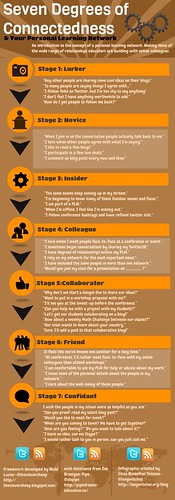
The 7 Degrees Infographic was collaboratively developed in an attempt to qualify the wide range of relationships we experience online. My original blog post later led to this K-12 Online Conference presentation that goes into more detail about the tools and connections many are now familiar with.
Knowing that ETMOOC participants are engaging in many and varied experiences with co-learners, I'd be interested to know whether or not these stages resonate with participants. For those new to blogging, tweeting and sharing online, it might be even more enlightening to revisit this infographic at the end of the course.
HOT OFF THE PRESSES: My colleagues on the eastern side of the planet have just released Twitter: A Cultural Guidebook which is based on the 7 Degrees of Connectedness. What's more, it's a free download.
Saturday, March 3, 2012
Which Connections Matter Most?
Over the past week, I've been trying to come to terms why Jabiz Raisdana's recent post, Be More Interesting, resonated so authentically for me. Although many of my colleagues differentiate their relationships depending on whether they take place in virtual spaces or in the physical world, my personal experience tells me that it is the blending of these two worlds that makes for the most meaningful connections of all. Having invested so much time and attention to my own networked learning, I find myself relishing the deepest of these professional learning connections (For more on this idea, see Deeper Connections Matter More).
Multiple interactions over time, when blended with occasional face-to-face meetings, results in a familiarity one might not expect. Now that technology has made it possible for both online and real world conversations to take place face-to-face, ongoing intellectual relationships might grow to be perceived as emotional connections. The more we come to know our online colleagues, the more we come to care about them. In many ways, these relationships of choice are more tantalizing than those relationships we experience by the coincidence of a shared staffroom.

After thinking, sketching, and thinking some more, I created a diagram to help me make sense of the professional learning connections I've made in recent years. Although the actual placement of items on the grid varies depends on many factors, it's clear that my relationships with those I've met face-to-face or voice-to-voice, tend be the deepest both intellectually and emotionally. Online colleagues like Jabiz, challenge me to think more deeply than most, in large part because I can see his gestures and hear his voice when I read his words.
Have we met face to face? If so, does it change the way you read this post? Which professional conversations are most compelling to you? Do your online relationships matter more or less than your relationships with local colleagues? Can you differentiate between those connections you make on the basis of an intellectual connection, and those where you feel emotionally invested?
Multiple interactions over time, when blended with occasional face-to-face meetings, results in a familiarity one might not expect. Now that technology has made it possible for both online and real world conversations to take place face-to-face, ongoing intellectual relationships might grow to be perceived as emotional connections. The more we come to know our online colleagues, the more we come to care about them. In many ways, these relationships of choice are more tantalizing than those relationships we experience by the coincidence of a shared staffroom.
After thinking, sketching, and thinking some more, I created a diagram to help me make sense of the professional learning connections I've made in recent years. Although the actual placement of items on the grid varies depends on many factors, it's clear that my relationships with those I've met face-to-face or voice-to-voice, tend be the deepest both intellectually and emotionally. Online colleagues like Jabiz, challenge me to think more deeply than most, in large part because I can see his gestures and hear his voice when I read his words.
Have we met face to face? If so, does it change the way you read this post? Which professional conversations are most compelling to you? Do your online relationships matter more or less than your relationships with local colleagues? Can you differentiate between those connections you make on the basis of an intellectual connection, and those where you feel emotionally invested?
Tuesday, February 21, 2012
We Glow Like Fireflies
Have you noticed there are more of 'us'?
If you haven't noticed, then you haven't been paying attention.

More than ever, educators have taken to social media in general, and Twitter in particular, to connect with like-minded colleagues.
Like fireflies, we're letting ourselves be known to one another through the use of our own secret signals. Tweets are being used to build communities of learners on levels never seen before. Hashtags are binding learners who share common interests and a common vocation.
If you were on Twitter three years ago, you might have participated in the first synchronous educational chat. Like so many fireflies, we were in wonder at the discovery of so many educators ready to talk about teaching and learning.
 After taking time to introduce ourselves to one another, the tweets came so quickly, that it was next to impossible to keep up. Looking back at an interesting parallel, I'm smiling in the knowledge that it was in the quiet of the nighttime that we found one another.
And it continues today...
We use Twitter to hail distant colleagues.
We nudge local teachers to share their own firelight.
We inhabit a digital staffroom where the the lights are always twinkling.
We do deep in our thinking - #edbookclub.
We follow distant conferences - #educon.
We play games - #namethattune.
We think in public - #pencilchat.
We build relationships - #PLN.
We become a community - #ds106.
We find ways to let our light shine... on our own time... in the night time.
And though we sometimes dim our lights, going dark to live in the physical world, we always come back. We're drawn to the light of an ever-growing cadre of educators who, to paraphrase Rob Fisher, "care so much about teaching and learning that it hurts."
 Time lapse photos of Japanese fireflies were the inspiration for this post. I first encountered them in my daily 'Wired' news feed, and after following a few links, I discovered that they have been re-posted multiple times by fans. Finding the original images on the Digital Photo Blog, I was happy to discover that the images are licensed for sharing under a Japanese CC license by Tsuneaki Hiramatsu.
If you haven't noticed, then you haven't been paying attention.

More than ever, educators have taken to social media in general, and Twitter in particular, to connect with like-minded colleagues.
Like fireflies, we're letting ourselves be known to one another through the use of our own secret signals. Tweets are being used to build communities of learners on levels never seen before. Hashtags are binding learners who share common interests and a common vocation.
If you were on Twitter three years ago, you might have participated in the first synchronous educational chat. Like so many fireflies, we were in wonder at the discovery of so many educators ready to talk about teaching and learning.
 After taking time to introduce ourselves to one another, the tweets came so quickly, that it was next to impossible to keep up. Looking back at an interesting parallel, I'm smiling in the knowledge that it was in the quiet of the nighttime that we found one another.
 And it continues today...
We use Twitter to hail distant colleagues.
We nudge local teachers to share their own firelight.
We inhabit a digital staffroom where the the lights are always twinkling.
We do deep in our thinking - #edbookclub.
We follow distant conferences - #educon.
We play games - #namethattune.
We think in public - #pencilchat.
We build relationships - #PLN.
We become a community - #ds106.
We find ways to let our light shine... on our own time... in the night time.
And though we sometimes dim our lights, going dark to live in the physical world, we always come back. We're drawn to the light of an ever-growing cadre of educators who, to paraphrase Rob Fisher, "care so much about teaching and learning that it hurts."
 Time lapse photos of Japanese fireflies were the inspiration for this post. I first encountered them in my daily 'Wired' news feed, and after following a few links, I discovered that they have been re-posted multiple times by fans. Finding the original images on the Digital Photo Blog, I was happy to discover that the images are licensed for sharing under a Japanese CC license by Tsuneaki Hiramatsu.
 Wednesday, February 1, 2012
Roll Down the Windows
Every day brings changes to our world. Tools evolve; ideas emerge; projects are born. Through your personal learning network, you are already immersed in this change; but what about everyone else?
Your face-to-face colleagues may not truly understand it, but by now, they probably realize that you are part of some larger learning community. I like to suggest that it's time to take these colleagues by the hand, and to introduce them to this dynamic online world of professional learning. The good news is that there is an easy, and not-so-intimidating way to do it.
 Like a dog in a car, the world just whizzes by, seemingly beyond our control. Even so, we choose to participate. We engage in conversations that matter. We keep informed about what our colleagues are doing. We amplify the best ideas we encounter. We share.
Sadly, many of our colleagues are so immersed in the day to day experience, that they may as well be riding along behind tinted windows that are rolled up tight. Focusing only on the path they're on, most of our fellow teachers have no idea of the range of thought-provoking conferences, collaborative projects, or innovative tools that are just outside the window.
How do we best introduce teachers to the test pilots among us who are creating and sharing a new vision for education?
 My number one suggestion, is to invite your co-workers to roll down the windows in order to get a sense of what's happening in connected classrooms around the corner, and around the world. It's easier than you might think.
You don't have to share a new teaching strategy.
You don't have to impress with the latest gadgets or web tools.
You don't have to coach the development of personal learning networks.
You don't have to introduce Twitter, or hashtags, or social media.
You don't need to teach about curation or subscriptions.
Begin by rolling the window down just a crack, and your colleagues can experience a world of continuous learning. Here are just a few ways to introduce your fellow teachers to people and ideas that inspire.
1. Share the link to one crowd-sourced online newspaper.
The Tweeted Times is where I get my morning fix for the stories I may have missed the previous day. Another I visit for stories shared by my Ontario colleagues, is Doug Peterson's: The Best of Ontario-Educators Daily.
2. Point colleagues to one news feed.
Here, educators can read engaging stories that highlight the thinking of fellow change agents. The stories change every day, but the link stays the same.
3. Share a link to one of the pages you use to collect bookmarks.
Your entire bookmark library may be of interest, but you might also share only a specific tag like 'classrooms of tomorrow'. When you find something, they'll know where its at.
4. Point app-lovers to one education news aggregator.
A few years ago, I developed 'Clever App', a tool I use to access the news from my PLN at least a few times each week.
5. Send your friends to one great blog each week.
If you're a regular reader of blogs, why not share the feeds to some of your favourite writers?
6. Email one story a day.
You have access to dozens, but a teacher who never seems to have the time, might get hooked on one a day if you choose wisely.
7. Pro tip: Automate
If you have yet to discover If This, Then That, you might be interested to know that you can automate delivery of news to your colleagues. If you tweet a link, have it automatically posted to your delicious feed or to your blog. If you bookmark a resource, have IFTTT automatically email it to your friends.
 Once they get a breeze in their hair, your colleagues might be eager to join teachers far and wide are learning and sharing everyday. On their very own, they may wind that window all the way down and ask you how they might more deeply engage in this world. It's then that Twitter, blogging, and personal learning networks might become part of the conversation.
What's holding you back? Go ahead and share one resource might lead a teacher to make a habit of professional reading every day. If you roll down the window, your colleagues may well engage in conversation across the hallway... or around the globe! It doesn't have to be overwhelming, just choose a simple way to share the powerful connections you've already discovered.
Photo credits: Zilla in the Car by Vagabond Shutterbug; Sheep in a Truck by smcgee; Coaster rider by Fellowship of the Rich
Your face-to-face colleagues may not truly understand it, but by now, they probably realize that you are part of some larger learning community. I like to suggest that it's time to take these colleagues by the hand, and to introduce them to this dynamic online world of professional learning. The good news is that there is an easy, and not-so-intimidating way to do it.
 Like a dog in a car, the world just whizzes by, seemingly beyond our control. Even so, we choose to participate. We engage in conversations that matter. We keep informed about what our colleagues are doing. We amplify the best ideas we encounter. We share.
 Sadly, many of our colleagues are so immersed in the day to day experience, that they may as well be riding along behind tinted windows that are rolled up tight. Focusing only on the path they're on, most of our fellow teachers have no idea of the range of thought-provoking conferences, collaborative projects, or innovative tools that are just outside the window.
How do we best introduce teachers to the test pilots among us who are creating and sharing a new vision for education?
 My number one suggestion, is to invite your co-workers to roll down the windows in order to get a sense of what's happening in connected classrooms around the corner, and around the world. It's easier than you might think.
You don't have to share a new teaching strategy.
You don't have to impress with the latest gadgets or web tools.
You don't have to coach the development of personal learning networks.
You don't have to introduce Twitter, or hashtags, or social media.
You don't need to teach about curation or subscriptions.
Begin by rolling the window down just a crack, and your colleagues can experience a world of continuous learning. Here are just a few ways to introduce your fellow teachers to people and ideas that inspire.
1. Share the link to one crowd-sourced online newspaper.
The Tweeted Times is where I get my morning fix for the stories I may have missed the previous day. Another I visit for stories shared by my Ontario colleagues, is Doug Peterson's: The Best of Ontario-Educators Daily.
2. Point colleagues to one news feed.
Here, educators can read engaging stories that highlight the thinking of fellow change agents. The stories change every day, but the link stays the same.
3. Share a link to one of the pages you use to collect bookmarks.
Your entire bookmark library may be of interest, but you might also share only a specific tag like 'classrooms of tomorrow'. When you find something, they'll know where its at.
4. Point app-lovers to one education news aggregator.
A few years ago, I developed 'Clever App', a tool I use to access the news from my PLN at least a few times each week.
5. Send your friends to one great blog each week.
If you're a regular reader of blogs, why not share the feeds to some of your favourite writers?
6. Email one story a day.
You have access to dozens, but a teacher who never seems to have the time, might get hooked on one a day if you choose wisely.
7. Pro tip: Automate
If you have yet to discover If This, Then That, you might be interested to know that you can automate delivery of news to your colleagues. If you tweet a link, have it automatically posted to your delicious feed or to your blog. If you bookmark a resource, have IFTTT automatically email it to your friends.
 Once they get a breeze in their hair, your colleagues might be eager to join teachers far and wide are learning and sharing everyday. On their very own, they may wind that window all the way down and ask you how they might more deeply engage in this world. It's then that Twitter, blogging, and personal learning networks might become part of the conversation.
 What's holding you back? Go ahead and share one resource might lead a teacher to make a habit of professional reading every day. If you roll down the window, your colleagues may well engage in conversation across the hallway... or around the globe! It doesn't have to be overwhelming, just choose a simple way to share the powerful connections you've already discovered.
Photo credits: Zilla in the Car by Vagabond Shutterbug; Sheep in a Truck by smcgee; Coaster rider by Fellowship of the Rich
Wednesday, January 11, 2012
Deeper Connections Matter More
 It's been a full four years now that I've been fully engaged in cultivating an online personal learning network, but I find myself finding the greatest value in those connections that have deepened through repeated face to face contact. The heady days of December in 2007, when I first dipped my toe into Twitter, led me to a jaw-dropping awareness that I wasn't alone. There were hundreds of like-minded educators who were yearning to be affirmed in their belief that there were better ways to teach and learn... and I was eager to connect with them.
Fast forward to the turn of the new year, 2012, and my personal reflections have focused on the reality that I'm not so fully engaged in finding people to follow, or in cultivating a tribe of followers. In contrast, I'm reading and writing fewer tweets, and am taking the time to savour those connections that matter most.
How do I know you're one of the key nodes in my network?
1] We've met face to face at at least one conference or event.
2] We've had at least one conversation via Skype or Google Chat.
3] We've shared comments on one another's blog posts.
4] We've collaborated in developing a presentation/document/video/blog.
5] We've sought one another out to share 'big ideas'.
I think it's these meaningful connections with other change agents that I was most looking for in the first 25 years of my career. Now that many of the teacher-learners I first met on Twitter have become my trusted friends, I don't so much miss the one-way interactions with the more widely scattered nodes of my PLN. I still leverage the wisdom of my network on a daily basis, but rather than dipping into a never-ending stream of tweets, I am more likely to check the pulse of the group via a daily check of my personal news: The TweetedTimes.
Without question, Twitter is the glue of my personal network. But the connections I value most, reach well beyond the Twittersphere.
Wednesday, December 1, 2010
Expanding the PLN Playbook
I couldn't help but smile as I read George Siemens' 'most awesomest' commentary about PLNs. Exactly a year ago I wrote a shorter but similarly themed post, asking teacher-learners to see themselves as 'collaborators'.
As a learner who is passionate about leveraging the passion and expertise among a diverse population of connected educators, it's reassuring to see more and more evidence of collaboration among edu-tweeps.

While folks new to Twitter, often reference their interactions as the "greatest professional learning experience ever", we need to recognize this public sharing environment as a first step into transparent professional development.

Maybe Twitter can be seen as the entry drug to more significant network collaboration? In all likelihood, it will take leaders to create opportunities beyond synchronous Educhat conversations, in order to remind educators that professional learning can be amplified by reaching beyond 140 characters.
To that end, what are you doing to create the next EDUCON, MOOC, or TEDx? Are you modeling risk and reaching beyond your comfort zone? How are you contributing to the evolution of our professional learning playbook?
Me? I'm working with an incredible team to breathe life into an event that promises to model collaboration on a scale that's never before been attempted; but that's story for the new year. ;-)
As a learner who is passionate about leveraging the passion and expertise among a diverse population of connected educators, it's reassuring to see more and more evidence of collaboration among edu-tweeps.

While folks new to Twitter, often reference their interactions as the "greatest professional learning experience ever", we need to recognize this public sharing environment as a first step into transparent professional development.

Maybe Twitter can be seen as the entry drug to more significant network collaboration? In all likelihood, it will take leaders to create opportunities beyond synchronous Educhat conversations, in order to remind educators that professional learning can be amplified by reaching beyond 140 characters.
To that end, what are you doing to create the next EDUCON, MOOC, or TEDx? Are you modeling risk and reaching beyond your comfort zone? How are you contributing to the evolution of our professional learning playbook?
Me? I'm working with an incredible team to breathe life into an event that promises to model collaboration on a scale that's never before been attempted; but that's story for the new year. ;-)
Wednesday, November 3, 2010
WE are Smarter than ME
Brian Eno is credited with inventing the term 'Scenius', as a tool to describe 'group genius' that tends to erupt serendipidously. Specifically, he's reported to have said "Scenius stands for the intelligence and the intuition of a whole cultural scene. It is the communal form of the concept of the genius."
This definition fits with the collaborative intelligence I've experienced for the past few years. Through a conscious effort to harness social media for personal and professional learning, I've confirmed that WE are smarter than ME.
 Innovation, whether in the education sector, or otherwise, comes when individuals give themselves permission to think creatively, and to share their ideas, inferences, and insights with the crowd. As a result, similar but coincidental "A-ha!" experiences will sometimes take place completely independent of one another.
Kevin Kelly, writing on The Technium, offers four characteristics of Scenius, each of which is characteristic of the Personal/Professional Learning Networks being cultivated by more and more connected teacher-learners:
• Mutual appreciation - When educators suggest they're going to try something unique, they get affirmation from members of their PLN. (E.g., A user tweets about hosting a Skype conference. Others affirm the idea; suggest guest speakers; and later, offer congratulations on the initiative's success.)
• Rapid exchange of tools and techniques -- When interesting discoveries are made online, they rapidly fire through the retweet circuit until connected learners have been brought into the loop. (E.g., From node to node, and network to network, a presenter's slidedeck; resources page; or recorded presentation, are shared on Twitter via hyperlink)
• Network effects of success - When innovative practices emerge, loosely connected participants, and random observers alike, readily acknowledge and celebrate the success. (E.g., Local and distant micro-bloggers use common hashtags to raise the profile of an Educon learning experience.)
• Local tolerance for the novelties -- Creative thinkers who challenge the status quo, are often respected in networked learning environments. (E.g., A dissenting view is shared on a blog post. Although discussion participants may disagree with one another, the post can be recognized and valued for inspiring thoughtful debate.)
The expertise of my co-learners seems to me, to be exponentially more powerful when hyperlinked together. Whether or not we call it 'scenius', there's little doubt it's changing the way I consume, communicate, and create. Have you noticed your network having similar effects on your learning?
Next step: Find out more about the 'hive mind' in Kevin Kelly's latest book, Out of Control.
Photo Credit: Elisabeth Audrey
This definition fits with the collaborative intelligence I've experienced for the past few years. Through a conscious effort to harness social media for personal and professional learning, I've confirmed that WE are smarter than ME.
 Innovation, whether in the education sector, or otherwise, comes when individuals give themselves permission to think creatively, and to share their ideas, inferences, and insights with the crowd. As a result, similar but coincidental "A-ha!" experiences will sometimes take place completely independent of one another.
 Kevin Kelly, writing on The Technium, offers four characteristics of Scenius, each of which is characteristic of the Personal/Professional Learning Networks being cultivated by more and more connected teacher-learners:
• Mutual appreciation - When educators suggest they're going to try something unique, they get affirmation from members of their PLN. (E.g., A user tweets about hosting a Skype conference. Others affirm the idea; suggest guest speakers; and later, offer congratulations on the initiative's success.)
• Rapid exchange of tools and techniques -- When interesting discoveries are made online, they rapidly fire through the retweet circuit until connected learners have been brought into the loop. (E.g., From node to node, and network to network, a presenter's slidedeck; resources page; or recorded presentation, are shared on Twitter via hyperlink)
• Network effects of success - When innovative practices emerge, loosely connected participants, and random observers alike, readily acknowledge and celebrate the success. (E.g., Local and distant micro-bloggers use common hashtags to raise the profile of an Educon learning experience.)
• Local tolerance for the novelties -- Creative thinkers who challenge the status quo, are often respected in networked learning environments. (E.g., A dissenting view is shared on a blog post. Although discussion participants may disagree with one another, the post can be recognized and valued for inspiring thoughtful debate.)
The expertise of my co-learners seems to me, to be exponentially more powerful when hyperlinked together. Whether or not we call it 'scenius', there's little doubt it's changing the way I consume, communicate, and create. Have you noticed your network having similar effects on your learning?
Next step: Find out more about the 'hive mind' in Kevin Kelly's latest book, Out of Control.
Photo Credit: Elisabeth Audrey
Monday, November 30, 2009
Collaborative Learning Networks

While each of us has an individualized way of interacting with co-learning colleagues, Dave Cormier's recent post and intermittent tweets have led me to regard the term Personal Learning Network as slightly 'oxymoronic'. My contributions to a group experience might be qualified as 'personal', but I would never use the word as an adjective to describe a team, a committee, or a class to which I belong. Maybe it's time to reconsider the use of the term PLN?
Personalized Learning & Participation
Each person's learning network is certainly unique. The tools we use to interact with our networks are chosen to suit our personal tastes, and the types of information we share among our colleagues varies widely; but the name we've come to accept for this inter-connected learning: Personal Learning Network, implies individual ownership and control.
Whether or not you subscribe to the theory of Connectivism, you likely realize that our networks are chaotic and self-organizing all at the same time.
A Collaborative Learning Network
The value in any learning network comes from the contributions of many individuals. No one member has ownership of the group, or of the work that's been collaboratively developed. Additionally, it's clear that if any one person fails to add value, then the net results are less striking.Do you have a Personal Learning Network?
Do you have a Collaborative Learning Network? or
Do you have something different?

Photo Credit: Elisabeth Audrey
Thursday, January 29, 2009
Twitter Mosaic
Thanks to Doug Peterson for pointing me to the Twitter Follower Mosaic tool, that makes it simple to publish a tapestry of your followers.
As a practical benefit, each image links directly to the Twitter feed of one of my followers. Feel free to check out what members of my network tweet about, and if you're on Twitter, choose a few of the most interesting to follow!


As a practical benefit, each image links directly to the Twitter feed of one of my followers. Feel free to check out what members of my network tweet about, and if you're on Twitter, choose a few of the most interesting to follow!
Subscribe to:
Posts (Atom)