Showing posts with label classrooms. Show all posts

Wednesday, February 2, 2011

'Learning Spaces' of Tomorrow

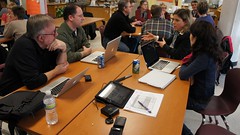
This past Sunday, Zoe Branigan-Pipe and I had an opportunity to work with teachers at the Science Leadership Academy. Titling our workshop, 'Classrooms of Tomorrow', our intent was to lead teachers to design solutions based on what they'd learned at Educon. Ideally, groups were to develop ideas into plans that could be implemented as soon as... tomorrow.

Zoe and I had spoken many times about how we might capture the conversational spirit of Educon, and in the end, we decided to leverage LiveScribe smartpen technology to archive the conversations of on-site participants. We were also purposeful in engaging our online audience, who also collaborated in the design of a learning space using Scribblar.

A Few EduConversations
The pencasts below are interactive. If you click on a button that says 'plan' or 'conversation', you'll be able to hear the discussion that led up to each group's design solution. Otherwise, you can click on any element in a groups design, to hear their thinking about that particular element. Each group was asked to design a space in consideration of 3 big ideas; so click on any keyword if you'd like to hear the group's rationale or design focus.

Design Team 1
brought to you by Livescribe


Design Team 2
brought to you by Livescribe


Design Team 3
brought to you by Livescribe


Design Team 4
brought to you by Livescribe


Although we couldn't capture the audio, our remote group had a conversation that resulted in the design of this space:


In the end, the word 'classroom' proved to limit the thinking of some participants who struggled to think outside of that box. As a result, our conversation is now called 'Learning Spaces of Tomorrow'. Consider this post as the public presentation of the ideas of our participants. What jumps out at you?

Photo Credit: Andy Forgrave

Monday, November 16, 2009

Classrooms of Tomorrow: The Untold Story

It's been almost two weeks since teachers at my school designed Classrooms of Tomorrow. What's most satisfying, is that already there are signs that teachers are adopting strategies that call for students to collaborate with one another.

So, What did teachers create?
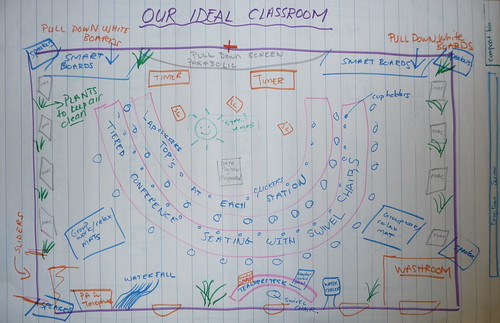
I've posted a series of classroom posters on my Flickr account in case you'd like to see what was designed. To hear more about what took place, including how teachers can assess learning by having conversations with learners, check out the podcast below.


Past episodes of the Teacher 2.0 podcast are available on iTunes.

Monday, January 28, 2008

Square Pegs and Soapboxes

Clarence Fisher in an open letter to Gary Stager writes:

"We are a new type of teacher working in new and changing learning environments. We are willing to experiment and drive towards new forms of learning. We fit into the education system like square pegs in round holes."

Bang on!

One of the main reasons that the pace of change in education is soooo frustratingly slow, is that as square pegs, we remain the minority.   It is only recently, thanks to a variety of Web 2.0 tools, that we've been able to find one another, and to positively reinforce our collective works to engage learners.  Events such as Educon 2.0 result in positive energy simply because so many are gathered with the same motivation.   The square pegs come to realize that they are on the right path in spite of the opposition they sometimes face in their local communities. Too bad for all of us, that so few round pegs even know that such events are taking place.

On our own, each of us may have to teach with doors closed so as not to offend the rest of the herd; it is only when clever sheep like Clarence Fisher find one another, that they can institute change that is noticeable on a grand scale.  By being on top of our virtual soapboxes, we are able to publish ideas that may just lead a few roundish pegs to gain sharp corners, and, over time, may result in large scale educational reform.
 
Courtesy of Ewan McIntosh comes this BBC news item: What Makes a Good Teacher?

"The big question now is whether - after 20 years of being told exactly what and how to teach - there are enough teachers ready to be "creatively subversive"?

If we were the majority, then Gary would notice changes in classroom environments... In order to get there, our voices, our ideas, our words have to be from high enough to be heard by as many teachers as possible.  Please don't come down off of your box yet Clarence, the movement towards Classroom 2.0 needs you!

Blogged with Flock

Wednesday, January 23, 2008

5 Cloud Technologies to Consider

It is wireless technology that put Thomas Friedman's 'earth flatteners' on steroids. Will cloud technologies have a significant impact on education? For this to happen, school districts will have to consider what roles will be played by the following puzzle pieces:

1] WiFi Networks: For the past 5 years or so, these networks have slowly moved from dream towards reality in blanketing cities across North America and Europe (Montreal, San Francisco, London...). Will school districts seriously consider the potential of wireless, especially in light of the following realities.

2] Sub-Notebooks: These'air'computers currently include the recently released Asus EEE, and Macbook Air. These computers begin the migration from powerful adaptable hardware, to micro-machines that can take advantage of wireless technologies to do online work. These 'windows to the web' may lead the change from shrink-wrapped software purchase to online software subscription.

3] Palm technology: From cell phones to iPods to PDA's and their many hybrid cousins, these powerful networking devices offer the chance for individuals (and classrooms) to network with people and with information, anytime, anywhere.

4] Tag Clouds: Millions of taggers are teaching the machine by tagging everything with keywords. The relationships among photos, hyperlinks, blog posts, and more are becoming 'understood' by the machines that govern the world wide web.

5] Digital Publishing: Anyone can publish for a global audience via text, images, or video; and they can access pixels at low or no cost.

These are not 'future' technologies, but present day realities. It's time to think seriously about how we will leverage these tools, not only from the grassroots, but from the technologically superior offices and boardrooms that oversee our classrooms.

Thursday, January 17, 2008

Old Style Networking

Yesterday, I had the pleasure of receiving a phone call from Bryon, a Faculty of Education candidate at the University of Toronto. The call came out-of-the-blue regarding one of many Rich Performance Tasks that my colleagues and I have written over the past few years. This call triggered some old-style networking to assist a young teacher in preparing to engage students in a rich cross-curricular task.

The story of the task being completed actually began two years ago, when I invited a number of forward thinking teachers to join me in writing performance tasks that would be modeled on the WebQuest format. Since having written the tasks, one colleague, Bill (the most talented hands-on technology educator I've ever met) has relocated to the mountains of British Columbia; others (like Todd, who wrote the Future City task) continue to work within the district; and I've moved on to a regional position representing the e-learning needs of regional school boards. While I'd lost touch with these folks, I'm thankful that Bryon's phone call, nudged me to reconnect with these talented colleagues.

An 'antique' form of communication (the telephone), led me to use an 'aging technology' (email), to update the City of the Future task... and it all happened within 12 hours. Pretty quick, but it pales in comparison to the wiki networking project that was completed in a similar period of time, thanks to a Twitter request a day earlier from Will Richardson.

It's richly rewarding to know that educators are still accessing these learning materials, and more satisfying still, to know that our work is impacting teachers and students around the globe. In a given 10 day period, our site receives almost 3000 page views from upwards of 60 countries! What is less satisfying, is that I'm well aware that the work of my local team has been under-utilized within our own district.


Networking to update resources on the site gave me a chance to smile at a few of our more popular tasks... Those interested in project based learning whether web-based or not, may well be interested in reviewing the differentiated tasks still hosted at the London District Catholic School Board: http://www.ldcsb.on.ca/schools/cfe/RPT/menu.html

Find out more about the history of this project in this week's Teacher 2.0 Podcast.

Tuesday, January 15, 2008

Ban Cell Phones (Until we can figure out how to make use of them!)

My school board is considering a ban on cell phones and other electronic gadgets. If the ban were to be implemented, it would include items such as ipods and blackberries, and teachers would be included (although the televised news report tonight suggested that staff would have the option of using these 'tools' in private areas).

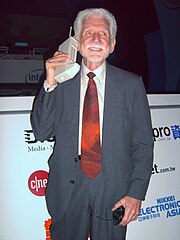
Cell phone technology, while once a luxury (remember the original portable phone?)cell phone? A quick history lesson may be of interest. Now, they are ubiquitous, and very powerful, with many models incorporating video, text, web-browsing and GPS. Now, I'm not saying that it's a good thing that these devices are everywhere, but I'm suggesting that the reason's for a complete ban, don't hold water.


Here is a summary of the reasons for the proposed ban as I understand them:

1] Cell phones can be used to arrange gang gatherings.
In fact, that the vast majority of people use communications devices to arrange lunch dates, or to check in with friends and family. While I can't prove it, I suspect that gang activity will not cease with the ban on overt use of cell phones.

2] Kids can cheat on tests with text messages.
Ask students to anonymously tell you how they've cheated on tests, and you'll no doubt find greater innovation that that! If a teacher is giving a fact regurgitation test to students in order to assess learning, I support the use of cell phones not only to text messages to others, but to bank notes as text files for easy access. I'd have to root for the poor student in just about any written test. 'Open phone test' anyone! Now that would get students doing real world networking and authentic problem solving!

3] Mean messages are being sent via both spoken word and text messaging.
This is wrong. We need to teach about cyber-bullying of all types. Think back to when kids in class wrote mean notes about one another, or drew naughty photos... Did we ban pencils and paper?! I actually think a ban on paper and pens would do more to push education forward... but let's start with a ban on chalk!.

4] Students are distracted awaiting calls and text messages from friends.
OK, I agree that we should have phones off and out of site during class. But don't forget, teens are really distracted by other teens more than anything else, and until students are banned from classrooms, boys and girls will always be dealing with this diversion.

5] Bomb threats have reportedly arisen from cell phone use.
Back in my day, students had to arrange for false fire alarms to get out of exams. Then again, phones still existed...

6] Cell phones are a popularly stolen item.
Only when not allowed to be 'on their person'! If we demand they keep cell phones with them at all times, theft of cell phones will all but disappear.

7] Inappropriate cell-camera photos and video recordings have been posted on the web.
With the proliferation of such powerful tools in the hands of young people, I am embarrassed to say that I know of no teachers in my region who have found a practical use for these types of cell-phones. If we were to harness the potential in these tools and teach appropriate uses for cameras, we might discover students using cell phones for positive creative output. To date, educators have dropped the ball on this front.

Perhaps what is called for is a reverse ban, requiring that teachers dream up ways to integrate the use of the modern cell phone as a powerful multi-use computer. Looking for ideas? Simply invite your students to text message their suggestions for practical cell-phone projects. (I'm now wondering what percentage of teachers have never sent or received and instant text message?)Now I'm wondering how the network television gurus have figured out how to engage youth via text-messaging waaaaaay before teachers...

This fast-twitch, multi-tasking generation is one that has adopted technology in ways their teachers can barely comprehend. Has anyone else noticed that a large numbers of students don't wear wrist watches anymore?!

A ban on cell phones will not eliminate phones from schools... rather, it will create an environment where a large number of students will become 'rule-breakers'. Surely many are already making and receiving calls surreptitiously by way of mosquito ring tones that can be heard only by younger ears. Realistically, I'm guessing that far more phones (and ipods) are present in a given school than administrators and teachers realize.

Like it or not, students will find ways of hiding their phones to avoid detection, and the nudges and winks among students will create a culture of people who feel justified in opposing authority on this stand. One has to wonder whether or not cellphone disguises be shared via the social networking sites teachers have yet to discover! My hope is that students will teach their teachers and administrators what they know about democracy , and will demonstrate democratic skills in seeking a compromise to this locally proposed ban.

Smaller, more powerful computing, communicating and music playing devices are sure to evolve. What will happen when the cell phone implant becomes the norm? Let's go back in time... Bring back the tooth phone implant invented in the summer of 2002! Well, maybe it was a hoax... Even so, such a story could be used to open a cell phone curriculum; teaching and modeling critical thinking skills.

I remember when schools banned us from using calculators on tests... every new technology has to be banned at some point I guess. Today it's social networking and cell phones that are seen as 'distractions'. One day, we may treat such technologies as educational tools; but before we can, it's going to take some forward thinking educators to put these powerful tools to educational use!

More to follow in Wednesday's podcast "Mary had a little lamb... er cell phone", but until then, I should share with you that some good could come from a ban. A New York City moratorium on cell phones at school may have created a new industry!