They're already here...
and every Teacher needs to know about them!
Technology has resulted in a number of significant changes in the ways people communicate, learn and create. This slideshow highlights a number of trends that should lead to significant changes in classrooms around the world.
Just in case anyone would like an audio explanation of the slides, here is the companion podcast:
Do you see any other significant changes that should lead to changes in the ways we teach & learn?
Showing posts with label networking. Show all posts
Showing posts with label networking. Show all posts
Wednesday, February 4, 2009

Monday, October 13, 2008
CCK08: 'Group' Semantics
Groups emphasize sameness;
Networks emphasize diversity;
Groups emphasize order and control;
Networks emphasize autonomy;
Groups emphasize borders and membership;
Networks emphasize openness;
Groups emphasize additive, cumulative knowledge;
Networks emphasize emergent knowledge.
 In reaching consensus around the connectivist definitions of these terms, I find myself wishing that we had more examples of networking in nature. Even so, the animal kingdom offers us many parallel words that can be translated into characteristics of 'groups':
School (fish): Whether fish or students, most schools consist of cohorts or classes who are destined to swim in unision... rogue fish or learners are less likely to thrive or survive in such an environment.
Hive (bees): Look for evidence of abundant activity, all for a common purpose.
Herd (caribou): A group driven to act in a common way for the benefit of the entire group.
Cast (crabs): When a collective takes on a large production, the organized group can achieve maximal benefits by having individual members specialize in the completion of distinct tasks.
Team (cattle): A group that works collaboratively to achieve a common goal will sometimes have members take on common roles, but might also assign distinct responsibilities based on individual expertise.
Gang (elk): Coming together intermittently, this is a disorganized group that acts reactively without need for a pre-determined purpose.
Pack (rats): Rather than acting constructively, this group attempts to 'bring down' others, rather than to contribute for the benefit of the group.
Mob (kangaroos): At times, a large group that is not formally organized, will coalesce in response to a specific catalyst.
Flock (gulls): Just as the movement in the stars/seasons caused a group of birds to migrate together, so too are distributed members of a group sometimes influenced by memes.
Huddle (penguins): This group would rather find answers from its own members rather than seek assistance or expertise from the outside.
Posse (turkeys): A group whose members have forged lasting connections over a period of time, gathers on an ad hoc basis as needs arise. Such groups are able to respond more quickly than many other groups, thanks in part to pre-existing familiarity among members.
Crowd (porpoises): A group that finds itself wanting to act after participating in a common experience such as a symposium, workshop, or presentation.
Pod (seals): Although the benefits to all members of the group are very similar, membership in a pod might be seen as more flexible, allowing an individual to be a member of more than one group.
Although I've discovered many examples of groups harnessing sameness and order to achieve collective benefits, similar parallels to the openness and autonomy of a network are more challenging to isolate. Maybe 'networking' is new to the animal kingdom; or perhaps such behaviors are learned and are indicative of higher level thinking?
I like to think that my online persona "The Clever Sheep" is an apt metaphor for the networked learner. I prefer to follow my own path, while leading others in new directions; to harness the expertise of my online peers, while contributing to the professional learning of like-minded colleagues.
Photo Credit: Yeimaya
Networks emphasize diversity;
Groups emphasize order and control;
Networks emphasize autonomy;
Groups emphasize borders and membership;
Networks emphasize openness;
Groups emphasize additive, cumulative knowledge;
Networks emphasize emergent knowledge.
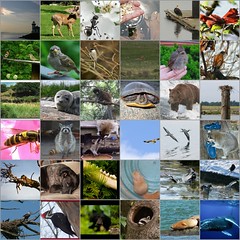 In reaching consensus around the connectivist definitions of these terms, I find myself wishing that we had more examples of networking in nature. Even so, the animal kingdom offers us many parallel words that can be translated into characteristics of 'groups':
School (fish): Whether fish or students, most schools consist of cohorts or classes who are destined to swim in unision... rogue fish or learners are less likely to thrive or survive in such an environment.
Hive (bees): Look for evidence of abundant activity, all for a common purpose.
Herd (caribou): A group driven to act in a common way for the benefit of the entire group.
Cast (crabs): When a collective takes on a large production, the organized group can achieve maximal benefits by having individual members specialize in the completion of distinct tasks.
Team (cattle): A group that works collaboratively to achieve a common goal will sometimes have members take on common roles, but might also assign distinct responsibilities based on individual expertise.
Gang (elk): Coming together intermittently, this is a disorganized group that acts reactively without need for a pre-determined purpose.
Pack (rats): Rather than acting constructively, this group attempts to 'bring down' others, rather than to contribute for the benefit of the group.
Mob (kangaroos): At times, a large group that is not formally organized, will coalesce in response to a specific catalyst.
Flock (gulls): Just as the movement in the stars/seasons caused a group of birds to migrate together, so too are distributed members of a group sometimes influenced by memes.
Huddle (penguins): This group would rather find answers from its own members rather than seek assistance or expertise from the outside.
Posse (turkeys): A group whose members have forged lasting connections over a period of time, gathers on an ad hoc basis as needs arise. Such groups are able to respond more quickly than many other groups, thanks in part to pre-existing familiarity among members.
Crowd (porpoises): A group that finds itself wanting to act after participating in a common experience such as a symposium, workshop, or presentation.
Pod (seals): Although the benefits to all members of the group are very similar, membership in a pod might be seen as more flexible, allowing an individual to be a member of more than one group.
Although I've discovered many examples of groups harnessing sameness and order to achieve collective benefits, similar parallels to the openness and autonomy of a network are more challenging to isolate. Maybe 'networking' is new to the animal kingdom; or perhaps such behaviors are learned and are indicative of higher level thinking?
I like to think that my online persona "The Clever Sheep" is an apt metaphor for the networked learner. I prefer to follow my own path, while leading others in new directions; to harness the expertise of my online peers, while contributing to the professional learning of like-minded colleagues.
Photo Credit: Yeimaya
Friday, September 12, 2008
Getting Beyond Parallel Processing
The dinner bell rang; Everyone came; Most sat silently through the appetizer...

The richness of the CCK08 course is not in the content, but in the interactions of the participants. Unfortunately, the conversation is not so likely to come to you, if you don't take the leap to attach your ideas to those of the others in the course.
Instead of working in parallel with the others in this course who are processing the rich information in the presentations and links shared by Stephen and George, I think more can be accomplished if we reflect, compare, contrast and build on the ideas of others.
As the main course of this rich meal comes to the table, I'll be making the effort to add my ideas to those of others in this course, maybe you'll do the same? Connectivism isn't found in the facts we process, but in the connections we make!
FYI, Today's Teacher 2.0 Podcast touches on this idea of parallel processing in the classroom.
Photo Credit: Groovnik

The richness of the CCK08 course is not in the content, but in the interactions of the participants. Unfortunately, the conversation is not so likely to come to you, if you don't take the leap to attach your ideas to those of the others in the course.
Instead of working in parallel with the others in this course who are processing the rich information in the presentations and links shared by Stephen and George, I think more can be accomplished if we reflect, compare, contrast and build on the ideas of others.
As the main course of this rich meal comes to the table, I'll be making the effort to add my ideas to those of others in this course, maybe you'll do the same? Connectivism isn't found in the facts we process, but in the connections we make!
FYI, Today's Teacher 2.0 Podcast touches on this idea of parallel processing in the classroom.
Photo Credit: Groovnik
Wednesday, June 25, 2008
Will Different Become the Norm?
 The Connectivism and Connective Knowledge Open Course is ramping up with participants planning a number of networking events including face-to-face get-togethers. In "More is different..." George Siemens anticipates how scaling up a learning event to include hundreds of participants increases the complexity of the learning environment:
1. Less control on the part of the instructor
2. More need for learners to define and forage for needed content and relationships/learning connections
3. More noise, chaos, confusion
4. Greater flow of information, leading to individuals with high “network literacy” feeling more at ease in the course.
5. Greater involvement of learners in assisting each other
6. For some learners, increased need for centralized spaces that serve as “jumping off” points.
7. Reduced sense of singular expertise (i.e. facilitators) and greater reliance on ideas and expertise shaped through collaborative/collective discourse
8. Greater segmentation - learners will find others with similar interests and they will form small sub-groups as a means to cope with complexity and to individualize their learning
Although it wasn't always appreciated by my colleagues, many of these 'different' characteristics were signs to me that learning was taking place in my own 'small scale' classroom. Scaling up, these differences are also evident in the greatest mass classroom on the planet: the World Wide Web.
In leveraging current and evolving network structures in CCK08, my hope is that the characteristics predicted by George, will be emulated in future networked learning environments, both large and small.
Photo Credit: David Reece
Thursday, January 17, 2008
Old Style Networking
Yesterday, I had the pleasure of receiving a phone call from Bryon, a Faculty of Education candidate at the University of Toronto. The call came out-of-the-blue regarding one of many Rich Performance Tasks that my colleagues and I have written over the past few years. This call triggered some old-style networking to assist a young teacher in preparing to engage students in a rich cross-curricular task.
The story of the task being completed actually began two years ago, when I invited a number of forward thinking teachers to join me in writing performance tasks that would be modeled on the WebQuest format. Since having written the tasks, one colleague, Bill (the most talented hands-on technology educator I've ever met) has relocated to the mountains of British Columbia; others (like Todd, who wrote the Future City task) continue to work within the district; and I've moved on to a regional position representing the e-learning needs of regional school boards. While I'd lost touch with these folks, I'm thankful that Bryon's phone call, nudged me to reconnect with these talented colleagues.
 An 'antique' form of communication (the telephone), led me to use an 'aging technology' (email), to update the City of the Future task... and it all happened within 12 hours. Pretty quick, but it pales in comparison to the wiki networking project that was completed in a similar period of time, thanks to a Twitter request a day earlier from Will Richardson.
 It's richly rewarding to know that educators are still accessing these learning materials, and more satisfying still, to know that our work is impacting teachers and students around the globe. In a given 10 day period, our site receives almost 3000 page views from upwards of 60 countries! What is less satisfying, is that I'm well aware that the work of my local team has been under-utilized within our own district.


 Networking to update resources on the site gave me a chance to smile at a few of our more popular tasks... Those interested in project based learning whether web-based or not, may well be interested in reviewing the differentiated tasks still hosted at the London District Catholic School Board: http://www.ldcsb.on.ca/schools/cfe/RPT/menu.html
Find out more about the history of this project in this week's Teacher 2.0 Podcast.
The story of the task being completed actually began two years ago, when I invited a number of forward thinking teachers to join me in writing performance tasks that would be modeled on the WebQuest format. Since having written the tasks, one colleague, Bill (the most talented hands-on technology educator I've ever met) has relocated to the mountains of British Columbia; others (like Todd, who wrote the Future City task) continue to work within the district; and I've moved on to a regional position representing the e-learning needs of regional school boards. While I'd lost touch with these folks, I'm thankful that Bryon's phone call, nudged me to reconnect with these talented colleagues.
 An 'antique' form of communication (the telephone), led me to use an 'aging technology' (email), to update the City of the Future task... and it all happened within 12 hours. Pretty quick, but it pales in comparison to the wiki networking project that was completed in a similar period of time, thanks to a Twitter request a day earlier from Will Richardson.
 It's richly rewarding to know that educators are still accessing these learning materials, and more satisfying still, to know that our work is impacting teachers and students around the globe. In a given 10 day period, our site receives almost 3000 page views from upwards of 60 countries! What is less satisfying, is that I'm well aware that the work of my local team has been under-utilized within our own district.

 Networking to update resources on the site gave me a chance to smile at a few of our more popular tasks... Those interested in project based learning whether web-based or not, may well be interested in reviewing the differentiated tasks still hosted at the London District Catholic School Board: http://www.ldcsb.on.ca/schools/cfe/RPT/menu.html
Find out more about the history of this project in this week's Teacher 2.0 Podcast.
Sunday, January 13, 2008
Let's Ban Chalk!
This weekend, I got to thinking about how history measures time periods. Knowing that the Three-Age System subdivided pre-history based on the material make-up of tools (the Stone Age, the Bronze Age, the Iron Age), I'd like to propose a system of 'ages' as a lens through which we can view classrooms in recent years.
In considering the 'tools' that have been mainstays in classrooms from the time when learning moved indoors in North America, we can frame education into three eras:
 The Slate & Chalk Age (mid 1800's - present)
Characteristics: records are temporary; memory is necessary
 The Paper & Pen Era (1900's to present)
Characteristics: records are semi-permanent; memory for homework is possible
 The Web & Keyboard Period (2000's to present) Characteristics: records are of multimedia and may be historic; searchability makes memory less critical;
In looking for links to support these time periods, I stumbled across a wonderfully concise explanation courtesy of PBS.
In identifying the Web & Keyboard Period, I'm naming the period after the tools used to write, but the implication is that we have to consider this to be a period where students produce content in as many varied mediums as they experience. The true tools would include microphones, cameras, and other evolving input devices, well beyond the keyboard and mouse. Remember, in 2006, YOU were being named TIME's Person of the Year, not for your reading and writing, but as part of "a story about community and collaboration on a scale never seen before."
But many educators are still tied to both chalk/chalkboards; and paper/pen remain the preeminent classroom tool. In order to hasten the arrival of School 2.0, a time when the norm for classrooms is for the world wide web to be ever-present as the 'chalkboard', "I propose we Ban Chalk!"
While initially tongue in cheek, this proposal is one that would demand teachers change their practice. We may eventually want ban or put strict limits on paper, but I believe that the fist step is to change the blackboard. The physical space that makes up today's classroom, is reflective of rooms over 100 years ago. Changing the blackboard to a projection screen or SmartBoard, makes a dramatic statement to students and educators that the game has changed.
The day when it is 'normal' for classrooms to harness the power of global networking by using the read/write web along with a range of multimedia tools can only become a reality when the environment is reflective of the learning that takes place within the space.
The Stone age didn't end when we ran out of stone, it ended when people abandoned stone tools in favour of a better product. If teachers can teach this historic concept, surely we can live it!
"It's time to step away from the chalkboard and to step into the present!"
My "Down with Chalk!" mini-rant began on the Teacher 2.0 Podcast.
In considering the 'tools' that have been mainstays in classrooms from the time when learning moved indoors in North America, we can frame education into three eras:
 The Slate & Chalk Age (mid 1800's - present)
Characteristics: records are temporary; memory is necessary
 The Paper & Pen Era (1900's to present)
Characteristics: records are semi-permanent; memory for homework is possible
 The Web & Keyboard Period (2000's to present) Characteristics: records are of multimedia and may be historic; searchability makes memory less critical;
In looking for links to support these time periods, I stumbled across a wonderfully concise explanation courtesy of PBS.
In identifying the Web & Keyboard Period, I'm naming the period after the tools used to write, but the implication is that we have to consider this to be a period where students produce content in as many varied mediums as they experience. The true tools would include microphones, cameras, and other evolving input devices, well beyond the keyboard and mouse. Remember, in 2006, YOU were being named TIME's Person of the Year, not for your reading and writing, but as part of "a story about community and collaboration on a scale never seen before."
But many educators are still tied to both chalk/chalkboards; and paper/pen remain the preeminent classroom tool. In order to hasten the arrival of School 2.0, a time when the norm for classrooms is for the world wide web to be ever-present as the 'chalkboard', "I propose we Ban Chalk!"
While initially tongue in cheek, this proposal is one that would demand teachers change their practice. We may eventually want ban or put strict limits on paper, but I believe that the fist step is to change the blackboard. The physical space that makes up today's classroom, is reflective of rooms over 100 years ago. Changing the blackboard to a projection screen or SmartBoard, makes a dramatic statement to students and educators that the game has changed.
The day when it is 'normal' for classrooms to harness the power of global networking by using the read/write web along with a range of multimedia tools can only become a reality when the environment is reflective of the learning that takes place within the space.
The Stone age didn't end when we ran out of stone, it ended when people abandoned stone tools in favour of a better product. If teachers can teach this historic concept, surely we can live it!
"It's time to step away from the chalkboard and to step into the present!"
My "Down with Chalk!" mini-rant began on the Teacher 2.0 Podcast.
Thursday, December 27, 2007
New Conversations for a New Year

Many forward thinking educators find themselves teaching with their classroom doors closed in order to avoid conflict with their colleagues who are teaching in more 'traditional' ways. If you are a teacher who would rather have the students speak, than have your own voice be heard; If you are a teacher who would rather have students work on engaging cross-curricular projects, than turn pages in textbooks; If you are a teacher who would rather provide access to a real world audience for student work, than grade and return student assignments, then there is a high probability that you are in need of opportunities to connect with like-minded educators!
The reality in the many schools I've taught in, and visited, is that teachers who strive to engage their students in engaging projects, often run the risk of being seen by their teaching collagues as 'rebels' or worse yet, teachers who lack 'discipline'. The fact that a teacher might have students up and out of their desks, speaking with other students, and demonstrating learning with tools other than pencils, pens and books, must be threatening to those who have only experienced working with compliant students sitting in rows and following the lead of the 'sage on the stage'.
Rather than engaging in meaningful collaborative learning with neighbouring teachers (whose doors might also be closed... if only to keep their students from seeing your active learners), educators on their way to becoming 'Teacher 2.0', might be better to open discussions with peers whose classrooms are undertaking similar transformations: moving from the teacher-directed model to more constructivist, project-based learning approaches. Luckily, many of these teachers have opened virtual doorways to their classrooms via the World Wide Web.
While you may or may not have your students use read/write tools like Wikis, Blogs, and Podcasts, you might well find inspiration from seeing the work of others who are leveraging these tools to engage in global conversations. I know that many of these classrooms/teachers are looking to network with other classrooms from around the world, so by all means, consider participating in the discussion!
Conversation Starters:
View some Teacher/Classroom Blogs: http://classblogmeister.com/
EduBlog Award Nominees: http://edublogawards.com/
Educational Podcast Network: http://www.epnweb.org/
A few Folks you might want to meet/read:
Wesley Fryer: http://www.speedofcreativity.org/
Will Richardson: http://weblogg-ed.com/
Bob Sprankle: http://www.bobsprankle.com/welcome/welcome.html
Saturday, December 22, 2007
From Me to We
From Networked Learning in a Networked World (courtesy of Weblogg-ed) "The problem of the edublogasphere (and actually the whole blogasphere) in the context of learning is that people in the sphere do not - at least often - form any groups (an entity of individuals with an objective)."
It seems to me that formalized 'group network learning' and 'online collaboration' only happen when something is a stake. A larger purpose or project is needed as a focus to draw people together.
I've experienced this reality in more than one way:
1] In working with students and mentors with David Neils at Telementor.org, one of the realities that came to light was that mentor-protege relationships are most effective when a project acts as the focus for the interactions. Diverse experiences and ideas necessarily contended with one another, and constructed with one another.
2] In leading teachers through an online course, focus questions were indispensable in launching meaningful discussions. Our online work was narrowly focused. Questions that encourage variable viewpoints are not always easy to come by. (Individual bloggers often align with like minds, missing out on such challenging interactions.)
3] In collaborating to develop common approaches to lead teachers to the use of e-learning tools in Ontario, my regional colleagues and I found great traction in developing sharable resources through Wiki documents. Our online work had a clear purpose.
Each of these online interactions was meaningful because something was at stake, amplifying motivation for all participants.
When Will Richardson shares "My learning has a general focus and direction, to be sure, but it’s trajectory is determined by whatever is in my aggregator or on my screen at the moment."
This thought affirms for me my discovery that independent learning and exploration through chosen feeds/channels is effective for creative tangential discovery; but not for 'product'ivity. For a product to result, a team has to come together with a common goal (be it a conference, presentation, paper, resource...).
'Individual network learning' may not be an oxymoron... it may simply be the way individual online voices seek content from their networks: downloading for incentive to upload. (e.g., the Blogger whose livliehood depends on individual posts/presentations; the student trying to complete a research paper.)
'Group network learning' on the other hand, has many contributing via upload, so that in the end, the group has something worth sharing with the world via downloading! (e.g., The Future of Learning in a Networked World conference; Open Source software development; Wikipedia).

My four year old at his first soccer game had the wisdom to network before moving towards a common 'goal'. I wonder how many of the individual voices in the blogosphere are yearning like I am, for collaborative projects in which to vest their mutual interests... Project-Based Learning anyone?!
It seems to me that formalized 'group network learning' and 'online collaboration' only happen when something is a stake. A larger purpose or project is needed as a focus to draw people together.
I've experienced this reality in more than one way:
1] In working with students and mentors with David Neils at Telementor.org, one of the realities that came to light was that mentor-protege relationships are most effective when a project acts as the focus for the interactions. Diverse experiences and ideas necessarily contended with one another, and constructed with one another.
2] In leading teachers through an online course, focus questions were indispensable in launching meaningful discussions. Our online work was narrowly focused. Questions that encourage variable viewpoints are not always easy to come by. (Individual bloggers often align with like minds, missing out on such challenging interactions.)
3] In collaborating to develop common approaches to lead teachers to the use of e-learning tools in Ontario, my regional colleagues and I found great traction in developing sharable resources through Wiki documents. Our online work had a clear purpose.
Each of these online interactions was meaningful because something was at stake, amplifying motivation for all participants.
When Will Richardson shares "My learning has a general focus and direction, to be sure, but it’s trajectory is determined by whatever is in my aggregator or on my screen at the moment."
This thought affirms for me my discovery that independent learning and exploration through chosen feeds/channels is effective for creative tangential discovery; but not for 'product'ivity. For a product to result, a team has to come together with a common goal (be it a conference, presentation, paper, resource...).
'Individual network learning' may not be an oxymoron... it may simply be the way individual online voices seek content from their networks: downloading for incentive to upload. (e.g., the Blogger whose livliehood depends on individual posts/presentations; the student trying to complete a research paper.)
'Group network learning' on the other hand, has many contributing via upload, so that in the end, the group has something worth sharing with the world via downloading! (e.g., The Future of Learning in a Networked World conference; Open Source software development; Wikipedia).

My four year old at his first soccer game had the wisdom to network before moving towards a common 'goal'. I wonder how many of the individual voices in the blogosphere are yearning like I am, for collaborative projects in which to vest their mutual interests... Project-Based Learning anyone?!
Friday, December 21, 2007
Linear Brains and Soft Returns
One autumn morning in 1999, I had the opportunity to attend a hands-on workshop to learn how to use Microsoft Office. I walked away learning only one new skill, but it has saved me innumerable frustrations with aligning text in a wide range of computer programs. The skill, was the soft return. You may already know that using the return/enter key, along with the shift key, ensures that text wraps onto the next line (as opposed to beginning a new paragraph), but you may be surprised at how many keyboarders are unaware of this command. That one tip, made the 90 minute workshop worthwhile for me. Since that day, I've used the 'soft return' as a gauge for the usefulness of a professional development workshop.
Uh Oh! Students are learning on their own every day! Whether learning to use MS Office, or producing content for a social networking site, independent learners often live in ignorance of their own learning gaps. Consider this fact amidst the reality that many young people are learning online skills before their teachers have even heard of the technologies, and we have a problem not easily rectified!
How can educators provide thoughtful advice to digital natives in this reality? We can't... Unless we get learning ourselves! Teachers need to experience the tools over time in order to understand their appeal, and to consider ways of harnessing these tools for educational purposes.
But first, what hurdles must be overcome? I can think of a few:
Hurdle #1: Training on the use of Web 2.0 tools, needs to be done in an environment that suits the 'linear brains' of experienced teachers.
Hurdle #2: Techno-literate teachers are hard to come by! With few educators (and fewer administrators?) having the skills to lead such training, it will be challenging to move forward.
Hurdle #3: Late to the party, teachers will struggle to gain the respect of more experienced students.
With support from Mike Wesch and his students at Kansas State University, consider this soft return on how writing is different in the world of the Web:
Uh Oh! Students are learning on their own every day! Whether learning to use MS Office, or producing content for a social networking site, independent learners often live in ignorance of their own learning gaps. Consider this fact amidst the reality that many young people are learning online skills before their teachers have even heard of the technologies, and we have a problem not easily rectified!
How can educators provide thoughtful advice to digital natives in this reality? We can't... Unless we get learning ourselves! Teachers need to experience the tools over time in order to understand their appeal, and to consider ways of harnessing these tools for educational purposes.
But first, what hurdles must be overcome? I can think of a few:
Hurdle #1: Training on the use of Web 2.0 tools, needs to be done in an environment that suits the 'linear brains' of experienced teachers.
Hurdle #2: Techno-literate teachers are hard to come by! With few educators (and fewer administrators?) having the skills to lead such training, it will be challenging to move forward.
Hurdle #3: Late to the party, teachers will struggle to gain the respect of more experienced students.
With support from Mike Wesch and his students at Kansas State University, consider this soft return on how writing is different in the world of the Web:
Subscribe to:
Posts (Atom)