It all started when I read this Wired Magazine article about Hatsune Miku. I'm sure you'll be interested to see the recorded 'live' performance that resulted when creatives, building upon the work of one another, brought Hatsune to life.
Showing posts with label sharing. Show all posts
Showing posts with label sharing. Show all posts
Wednesday, December 12, 2012

Friday, June 5, 2009
Reading Aloud Allowed
 Wouldn't it be neat if we could create a space for children to share recordings of themselves reading their favourite books?
Children could hear voices young and old, in accents and languages from far away, as familiar words from picture books and novels were brought to life.
Listeners might read with unseen companions...
Performers might gain an audience...
Non-readers might experience the wonders of the written word...
Parents might volunteer to record their childhood favourites...
Boys & girls might learn from both male & female voices...
Reading might become more than decoding...
Teachers might subscribe to storybook podcasts...
iPods might be recognized as learning tools...
Reading buddies could get together any day or time...
Learners might discover voices inside themselves yearning to tell stories yet unwritten...
If such a site already exists, tell me about it; otherwise, I'll put it on my to-to list and start looking for collaborators!
Photo Credit: Jay Ryness
Wednesday, April 29, 2009
Do You Create Dolphin Bubbles?
Surely you create dolphin bubbles!
You're a creative person who is reading this because you love to learn, and you thrive on creating rich learning experiences for yourself and for others.
I came across this video courtesy of a tweet by Joe Evans. It reminds me that in creating original content, we do so as members of a community. Once created, do we keep our original content to ourselves, or do we celebrate, share, and honour our work by giving it away?
I'll think of my work on innovative projects as 'dolphin bubbles' for the next little while, and will do my best to be more generous than these captive dolphins are with their creations. While they are inventive with limited means, and are great at learning from one another, these dolphins can still learn a few things about sharing and Creative Commons!
Pssst! Please don't tell the dolphins that their actions have been videotaped, or the we may find ourselves in a situation...
See Larry Lessig's recent tweet!
Wednesday, February 4, 2009
12 Changes
They're already here...
and every Teacher needs to know about them!
Technology has resulted in a number of significant changes in the ways people communicate, learn and create. This slideshow highlights a number of trends that should lead to significant changes in classrooms around the world.
Just in case anyone would like an audio explanation of the slides, here is the companion podcast:
Do you see any other significant changes that should lead to changes in the ways we teach & learn?
and every Teacher needs to know about them!
Technology has resulted in a number of significant changes in the ways people communicate, learn and create. This slideshow highlights a number of trends that should lead to significant changes in classrooms around the world.
Just in case anyone would like an audio explanation of the slides, here is the companion podcast:
Do you see any other significant changes that should lead to changes in the ways we teach & learn?
Saturday, July 19, 2008
Teaching Them to Teach Themselves
By now most people are very familiar with the way that metadata tags are "Teaching the Machine". What is less commonly understood, is how tags can be leveraged to engage students in "Teaching Themselves".

Assuming that a teacher can create a unique identifier for a class or course (i.e., Lucier_physics_2008 or LucierSPH08-unit5), there are many ways to engage your students in the gathering of teaching and learning resources.
1] Invite students to post and tag Flickr images that match with concepts taught in class. Students might also add comments to existing photos.
2] Encourage students to share bookmarks on Delicious, Diigo or Furl. Link to videos, blog posts, photos, songs...
3] Promote the use of reflective journals in the form of blog entries that use the course identifier as a keyword or tag.
4] Add comments to blog posts that include your course identifier. While linking to rich thinking, you can model how learners might participate in educational dialogue within the blogosphere.
5] Demonstrate how comments can be added to YouTube or TeacherTube videos. "This video would be great for my LucierSPH08 course!"
6] Set up a Custom Search Engine to search specific sites for course-matching content. Tag the best of the best with your course/class code.
7] Add custom sections to a personalized news page. Consider simplifying the process by sending the RSS feed to Google Reader or another aggregator.
8] Demonstrate how to search blog entries for topical materials. Send custom searches to your feed aggregator for filtering.
9] Tag selected educational and current events podcasts. Many post-secondary institutions like Berkeley, Stanford, Yale, Penn State, Texas A&M, Duke, Queens, MIT offer access to lectures and other content. Consider subscribing to a few of the many terrific free podcasts available on iTunes. Shameless plug: Have you heard the Teacher 2.0 Podcast?
10] The advanced step: Set up live feeds to various content sources by aggregating tagged content to a community location by using a tool like PageFlakes or iGoogle.
Before launching such a social learning project with students, be sure to demonstrate the power of resource sharing by pre-tagging numerous resources specific to your course. A live demo using your course keyword should go a ways towards whetting the appetite of your students.
Who knows, by opening this conversation about sharing, you might even learn a few search tricks from your students! The video below by Jimmy Ruska, demonstrates what some students already know about effective searches for complimentary material, be it for music or university textbook content.
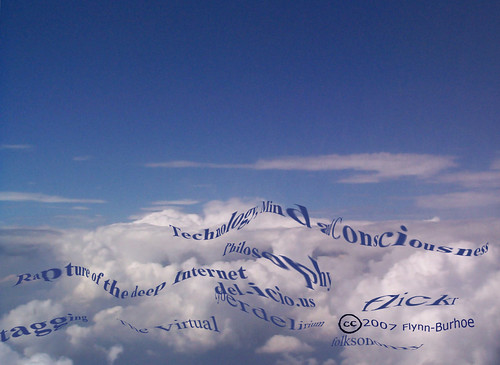
Photo Credit: Maureen Flynn-Burhoe
Assuming that a teacher can create a unique identifier for a class or course (i.e., Lucier_physics_2008 or LucierSPH08-unit5), there are many ways to engage your students in the gathering of teaching and learning resources.
1] Invite students to post and tag Flickr images that match with concepts taught in class. Students might also add comments to existing photos.
2] Encourage students to share bookmarks on Delicious, Diigo or Furl. Link to videos, blog posts, photos, songs...
3] Promote the use of reflective journals in the form of blog entries that use the course identifier as a keyword or tag.
4] Add comments to blog posts that include your course identifier. While linking to rich thinking, you can model how learners might participate in educational dialogue within the blogosphere.
5] Demonstrate how comments can be added to YouTube or TeacherTube videos. "This video would be great for my LucierSPH08 course!"
6] Set up a Custom Search Engine to search specific sites for course-matching content. Tag the best of the best with your course/class code.
7] Add custom sections to a personalized news page. Consider simplifying the process by sending the RSS feed to Google Reader or another aggregator.
8] Demonstrate how to search blog entries for topical materials. Send custom searches to your feed aggregator for filtering.
9] Tag selected educational and current events podcasts. Many post-secondary institutions like Berkeley, Stanford, Yale, Penn State, Texas A&M, Duke, Queens, MIT offer access to lectures and other content. Consider subscribing to a few of the many terrific free podcasts available on iTunes. Shameless plug: Have you heard the Teacher 2.0 Podcast?
10] The advanced step: Set up live feeds to various content sources by aggregating tagged content to a community location by using a tool like PageFlakes or iGoogle.
Before launching such a social learning project with students, be sure to demonstrate the power of resource sharing by pre-tagging numerous resources specific to your course. A live demo using your course keyword should go a ways towards whetting the appetite of your students.
Who knows, by opening this conversation about sharing, you might even learn a few search tricks from your students! The video below by Jimmy Ruska, demonstrates what some students already know about effective searches for complimentary material, be it for music or university textbook content.
Photo Credit: Maureen Flynn-Burhoe
Wednesday, March 26, 2008
ペチャクチャ : Pecha Kucha: Common Sense
That's Pecha Kucha"peh-chak-cha": (i.e., chit chat in Tokyo?!).
Who'd have thought that common sense in sharing knowledge via in-person talks would result in a 'movement' in the 21st Century?!
 Pecha Kucha is a presentation format that encourages creative folks to share ideas in a condensed format of 20 slides of 20 seconds each. Essentially, presenters boil down their presentation to 'just the good stuff'. The short presentations allow many ideas to be presented in a single evening (or session), and are far more likely to maintain the engagement of the audience.
I was first introduced to the name of this format by Geoff Day through an online response to a blog post, but the logic of short, high impact presentations is well known to anyone who regularly visits "TED: Ideas Worth Sharing". Those who have to sit through protracted presentations with few highlights, would also gravitate towards Pecha Kucha evenings, whether in the UK, New York, San Francisco, Amsterdam, Buenos Aires, Canberra, Montreal or elsewhere!
 Tomorrow, I will be leading a round-table discussion with district e-learning contacts from 16 regional school districts, each of which has been invited to share a distinctive practice/strategy/idea that has taken root in the home school board. Experience tells me that wisdom is not often recognized where it lives... and my hope is that sparks of creativity and innovation, will find tinder in the attendant board representatives. With a receptive, risk-taking audience, chances are good that the afternoon will lead to an expansion of best practices in online learning across southwestern Ontario.
Who knows, maybe the act of participating in short sharing sessions will lead to changes in the way boards share expertise... and the way they provide professional development!?!
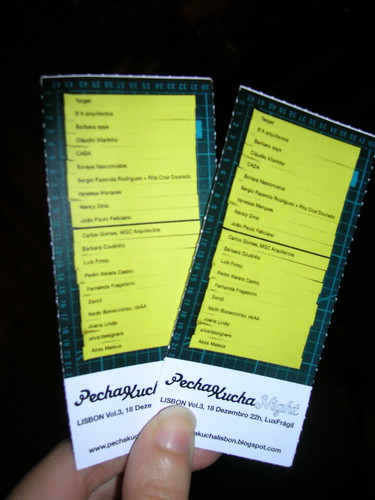
Photo Credits: Catalina; Escalla
Who'd have thought that common sense in sharing knowledge via in-person talks would result in a 'movement' in the 21st Century?!
 Pecha Kucha is a presentation format that encourages creative folks to share ideas in a condensed format of 20 slides of 20 seconds each. Essentially, presenters boil down their presentation to 'just the good stuff'. The short presentations allow many ideas to be presented in a single evening (or session), and are far more likely to maintain the engagement of the audience.
I was first introduced to the name of this format by Geoff Day through an online response to a blog post, but the logic of short, high impact presentations is well known to anyone who regularly visits "TED: Ideas Worth Sharing". Those who have to sit through protracted presentations with few highlights, would also gravitate towards Pecha Kucha evenings, whether in the UK, New York, San Francisco, Amsterdam, Buenos Aires, Canberra, Montreal or elsewhere!
 Tomorrow, I will be leading a round-table discussion with district e-learning contacts from 16 regional school districts, each of which has been invited to share a distinctive practice/strategy/idea that has taken root in the home school board. Experience tells me that wisdom is not often recognized where it lives... and my hope is that sparks of creativity and innovation, will find tinder in the attendant board representatives. With a receptive, risk-taking audience, chances are good that the afternoon will lead to an expansion of best practices in online learning across southwestern Ontario.
 Who knows, maybe the act of participating in short sharing sessions will lead to changes in the way boards share expertise... and the way they provide professional development!?!
Photo Credits: Catalina; Escalla
Thursday, March 6, 2008
Teaching the Machine: Part V
You've got to watch out for those instant teller machines... They may know a bit too much!
 Did you ever stop to consider what the computers would know about our personal spending lives if they were to get their networked brains together? Our spending patterns, our passwords, our digital signatures are all known to the microchips in these vastly interconnected computers. Although I doubt the hardware would be at all interested in spending my money, maybe the Machine would like to arrange for the transfer of funds to cover that money I was promised from that African prince via email...
Rather, I think that the artificially intelligent Machine would have a greater sense of equity than that. I suspect that the Machine's desire for balance and harmony, in place of inequity and chaos, might actually allow the heart of the Machine to strive to correct the inherent imbalance seen in global markets. A networked machine would surely refuse to allow parts of itself to suffer malnourishment, be it technological, intellectual, or otherwise. Would such a machine be more humane than humans? Maybe we should be the first to consider allocating global resources more equitably?
While we don't know what will happen if/when the Machine begins to act on its own, there are two sides of the coin worth considering:
The Good News: the Machine will have been programmed by hundreds of millions of programmers including you and I;
The Bad News: See above!
Photo Credit: Gerard Van der Leun
 Did you ever stop to consider what the computers would know about our personal spending lives if they were to get their networked brains together? Our spending patterns, our passwords, our digital signatures are all known to the microchips in these vastly interconnected computers. Although I doubt the hardware would be at all interested in spending my money, maybe the Machine would like to arrange for the transfer of funds to cover that money I was promised from that African prince via email...
Rather, I think that the artificially intelligent Machine would have a greater sense of equity than that. I suspect that the Machine's desire for balance and harmony, in place of inequity and chaos, might actually allow the heart of the Machine to strive to correct the inherent imbalance seen in global markets. A networked machine would surely refuse to allow parts of itself to suffer malnourishment, be it technological, intellectual, or otherwise. Would such a machine be more humane than humans? Maybe we should be the first to consider allocating global resources more equitably?
While we don't know what will happen if/when the Machine begins to act on its own, there are two sides of the coin worth considering:
The Good News: the Machine will have been programmed by hundreds of millions of programmers including you and I;
The Bad News: See above!
Photo Credit: Gerard Van der Leun
Subscribe to:
Posts (Atom)