You've got to watch out for those instant teller machines... They may know a bit too much!
Did you ever stop to consider what the computers would know about our personal spending lives if they were to get their networked brains together? Our spending patterns, our passwords, our digital signatures are all known to the microchips in these vastly interconnected computers. Although I doubt the hardware would be at all interested in spending my money, maybe the Machine would like to arrange for the transfer of funds to cover that money I was promised from that African prince via email...
Rather, I think that the artificially intelligent Machine would have a greater sense of equity than that. I suspect that the Machine's desire for balance and harmony, in place of inequity and chaos, might actually allow the heart of the Machine to strive to correct the inherent imbalance seen in global markets. A networked machine would surely refuse to allow parts of itself to suffer malnourishment, be it technological, intellectual, or otherwise. Would such a machine be more humane than humans? Maybe we should be the first to consider allocating global resources more equitably?
While we don't know what will happen if/when the Machine begins to act on its own, there are two sides of the coin worth considering:
The Good News: the Machine will have been programmed by hundreds of millions of programmers including you and I; The Bad News: See above! Photo Credit: Gerard Van der Leun
Are you up for a thought experiment? I'm thinking about how the global Machine might evolve...
The interconnected machine that is the World Wide Web, is learning from us every minute of every day. What would be the consequences of bringing a consciousness to this networked entity? While I can't say for sure, I'd like to take a leap and make some guesses at how interactions of millions of human beings who are online at any given moment, might be interpreted by 'the Machine'. What happens to the 'intelligence of the Machine' when we link ideas to one another in posting a Wikipedia entry? The Machine comes to know what the most popular 'facts' are; and to realize that these same facts change, depending upon who is judged to be the editing authority! If the Machine discovers that it too, has the authority to edit commonly understood facts, might the Machine 'rock our world'? If history holds true to form, then what is thought to be true today, will indeed be seen to be anything but wisdom, in the future. Will the Machine hasten our understanding, or hamper it?
What happens when we build relationships among different sources in a blog entry? The Machine will likely disconnect those relationships that are not popular, relying instead upon the most common beliefs to shape its own understanding. Might the Machine point bloggers to contradictory references and disparate opinions? With many bloggers and blog-readers content in limiting their interactions to like-minded individuals, might the Machine enlighten us by ensuring that we are exposed to balanced viewpoints? What are the effects of search interactions that provide feedback to the Machine? This 'programming by the masses' is likely our best crack at ensuring that the Machine will serve our needs. Every user that successfully navigates desired content, will increase the liklihood that a future searcher will be successful in a shorter amount of time. With successive findings, the Machine will indeed grow to be smarter at knowing what we are looking for. Perhaps it will even be able to anticipate our searches? I wonder if the Machine would see Epic 2015 as propaganda?
Are lessons from film to be known to our Machine? Although I would hope that the conscious interconnected brain of the world's mega-computer would be interested in working to its greatest potential, we might want to prepare for an alternate eventuality. Even the HAL 9000 initially saw itself as a valuable servant:
"I am putting myself to the fullest possible use, which is all I think, that any conscious entity can ever hope to do."
Will our Machine share a desire for self-preservation, and will feelings play a role? Dr. Dave Bowman wasn't sure about HAL: "He acts like has genuine emotions, of course he's programmed that way, to make it easier for us to talk to him. As to whether or not he has real feelings, is something I don't think anyone can truthfully answer."
Was HAL a PC or a Mac? Since he was born in 1992 (according to 2001: A Space Odyssey) he would've had to survive Y2K to get to 2001:
Since repairs to a global machine, conscious or not, are more complex than diving into the 'brain room', let's ensure that our machine learns the most valuable lessons we can offer... That people matter more than machines!
As a teacher; learner; consultant; speaker; and collaborator, I'm on the lookout for opportunities to engage in meaningful conversations with others who see themselves as learners. Professional development; project based learning; and Creative Commons are topics that are always on my radar.

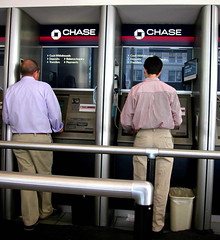 Did you ever stop to consider what the computers would know about our personal spending lives if they were to get their networked brains together? Our spending patterns, our passwords, our digital signatures are all known to the microchips in these vastly interconnected computers. Although I doubt the hardware would be at all interested in spending my money, maybe the Machine would like to arrange for the transfer of funds to cover that money I was promised from that African prince via email...