
Showing posts with label reading. Show all posts

Friday, January 18, 2013

Like Spokes on a Wheel

As the ETMOOC gets underway in earnest, many of the participants will be blogging about their learning, some for the very first time.  As participants draw connections between their ideas, these blog posts will rub up against one another, and like spokes centred on a common central idea, we'll all be able to move forward together.  This, in spite of the fact that reading habits, (and consequently writing habits) are changing.  These ideas led me to the two minute reflection below...


Related Posts:
We are Called to be Open Spokes in a Fidgital World by Ben Wilkoff
Imagining a Classroom without Blogs by Clarence Fisher


Photo credit: Spokes by kozzmen

Friday, June 5, 2009

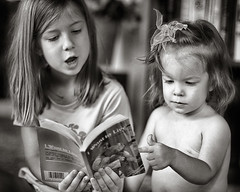
Reading Aloud Allowed

Wouldn't it be neat if we could create a space for children to share recordings of themselves reading their favourite books?

Children could hear voices young and old, in accents and languages from far away, as familiar words from picture books and novels were brought to life.


Listeners might read with unseen companions...

Performers might gain an audience...

Non-readers might experience the wonders of the written word...

Parents might volunteer to record their childhood favourites...

Boys & girls might learn from both male & female voices...

Reading might become more than decoding...

Teachers might subscribe to storybook podcasts...

iPods might be recognized as learning tools...

Reading buddies could get together any day or time...

Learners might discover voices inside themselves yearning to tell stories yet unwritten...


If such a site already exists, tell me about it; otherwise, I'll put it on my to-to list and start looking for collaborators!


Photo Credit: Jay Ryness

Wednesday, February 6, 2008

Which changed first? My Brain or the Book?

Has anyone else noticed that books are changing?

Chapters have become strings of bullet points rather than paragraphs. Paragraphs have been condensed to simple-to-read sound-bites on paper. Many books of today provide multiple headings supported by short paragraphs and are page-turners more for their white space and graphic nature than for their engaging content.

Is it because readers don't have the time? Do we fear missing out on something being written or said elsewhere? Amidst the sea of information, I find my eyes continually scanning for keywords and ideas rather than taking time to allow the full of an idea to wash over my brain. Things are changing both in the content and in the way I process the information.

I now scan e-news summaries clicking only the occasional full article; and when reading the full article, settle for the topic sentences rather than giving myself over to the full story. The advertisers think it's a limited attention span, serving up micro-commercials in comparison to the 60 or 90 second ads of my youth. But amidst a world giving itself over to text messages and Twitter, I think something different is going on here. Human beings are processing information differently!

Dare we teach this type of reading? Maybe Father Guido Sarducci's University is closer than we think?

Sunday, December 16, 2007

Reading is Changing

No, the focus of this entry is not the 'Kindle', Yahoo's recently launched e-book reader. I firmly believe that if people have to bring something along for the ride, an actual book is a lot more convenient! No batteries, no worries about theft, no need to download anything... just bring it along.

I believe the skill of reading is changing none-the-less. I know in my personal life, much of my reading is done reading text from my computer screen (PDFs, Web content, blogs...). My children also spend much of their time reading online text (albeit much of that written by their friends and classmates). With the sheer volume of text to be reviewed in a given day, it is proving to be necessary to be a different type of reader, than we were taught to be in school. With the explosion in content sure to continue, we need to prepare young people to be learners who are able to scan for keywords and topic sentences; to be researchers who are efficient at extracting key ideas; to be documentarians who can track their hyper-learning; to be judges, able to critically consider the validity and relevance of content.

While tools like 'Google Notebook' are available to help develop these skills, I'm not convinced that a wide cross-section of today's teachers is currently able to demonstrate these skills... Let alone, qualified to teach them. Although it's a number of years old already, Alan November's story "Teaching Zach to Think" is still very relevant, as is the November Learning "Websites to Validate" activity.

On the topic of Reading and Change:
Thanks to Wes Fryer (and others) for promoting the free e-books available from the MacArthur Foundation. From Moving at the Speed of Creativity: "If you’re looking for some holiday reading related to digital learning, check out this great set of free ebooks from MIT Press Journals and the MacArthur Foundation Series on Digital Media and Learning."