Wednesday, October 22, 2008

Top 20 Uses for Wordle


Wordle Wordle is a free 'word art' tool that crunches any chunk of text in the production of a visual representation of the content. The resulting graphic emphasizes the most common words by amplifying their size based on frequency. Originally designed to give pleasure, Wordle is being used in interesting ways to provide compelling summaries of political speeches, blog posts, twitter feeds, news articles and more, but there are additional educational uses worth considering.

A few ideas:

1] Convert a sonnet or Shakespearean play; or children's book (Dr. Seuss anyone?);

2] Paste the contents of an online discussion to coalesce the main ideas;

3] Combine student 'Who Are You?' introductions, or 'Superhero
Traits
' to develop a class composite;

4] Condense survey data by dumping content of questionnaire responses into the Wordle engine;

5] Combine news articles or RSS feeds on a given topic;

6] Turn an essay into a poster;

7] Combine blog posts over time into a simplified represetation or use it to compare the ideas of competing ideas;

8] Use font, colour and arrangement strategies to appropriately represent content;

9] Automate the creation of word poetry;

10] As an introduction to a unit or course, combine key words; themes; curriculum expectations to provide learners with a visual overview of content;

11] Convert nutritional content of one's weekly diet or of a group's menu preferences;

12] Condense a Wikipedia article into it's essence;

13] Paste the results of a Google search (Can you guess the keywords I used?);

14] Convert social bookmark tags;

15] Enter keywords from weekly weather reports to obtain a seasonal picture;

16] Distill song lyrics like "Stairway to Heaven";

17] Find out what you've been up to by summarizing To-Do lists;

18] Represent the results of a brainstorming session or the minutes of a meeting visually;

19] Show "Today in History" stories in a new way;

20] Convert past or current email messages into a composite of your correspondence;


Do you use Wordle? Have you considered using Wordle with students? If so, what other strategies would you recommend?

Saturday, October 18, 2008

CCK08: Six down; Six to go

This fall at school has been a blur both as a teacher and as a student. At reaching the mid-point in the CCK08 course, I'd like to share a number of observations, each of which might have become a blog post would time have been available.


1] Where is everyone? The number of 'active' course participants has settled to the point where receiving Moodle updates via email is a reasonable expectation. Beyond RSS feeds, I'm left wondering whether or not there is a mechanism to track continued involvement; and whether or not an exit survey would provide insight as to where/why so many have disappeared...

2] Just another online course? It's only in recent weeks when the 'noise' of the Moodle discussions has calmed down to the point that I'm willing to notice that learners are connecting their ideas to one another. Even though the 'Moodlers' are finally connecting, responses are still infrequently attached to the range of blog posts in the connect-osphere. Based on my own online teaching/learning experience, the CCK08 course is more and more feeling like a traditional online course.

3] Past Connectivist Life on the Back Burner! In order to keep up with selected readings, the Daily, and posts from my peers, I've lost touch with other aggregated feeds. (i.e., I haven't been reading many posts from outside of the course).

4] The Fourth 'R'! It took a while, but frequent posters finally seem to be building relationships and networks. In my own experience, I've found this feeling of 'knowing your classmates' to be a critical component in building an online community. While the random (chaotic?) grouping of participants has allowed for individual exploration, intentional grouping might have led more learners to engage more deeply. Early on, it was challenging to build relationships with so many disparate participants, and though the number of voices has dwindled recently, I believe this has actually benefitted those who continue to read/think/respond.

5] Differentiation... Not so much. Although classroom teachers have in recent years, embraced this concept to varying degrees, the assignments in this course have for the most part resulted in traditional responses (e.g., reflections; links to personal/professional practice). While the freedom to pursue areas of personal interest has been announced, 'similar-ation' has trumped 'differentiation'. Only the metaphors and blog titles seem to be unique.

6] A Daily Lifeline! With a real job, and a real family life, it's been challenging to reconcile the many CCK08 channels. The 'Daily' digest has let me keep in touch even on days when I couldn't read, listen to, or think about course content. I consider this document to be the glue that has been holding this course together.

7] Looking to Forge Links... I signed up for this course, in large part to experience connectivist learning first hand, but I've found time to reach out to only a limited number of colleagues. I think that making a more concerted effort to post to the Moodle would be a logical next step.

8] Synchronicity Works! With the participation of guest panelists, these discussions have been my favourite way to connect with learners. Whether live or recorded, these interactive sessions have provided opportunities for interaction among all present learners, be they instructors or 'back-channel' participants. Often beginning with semi-traditional lectures, participant questions and comments have sometimes led these discussions to interesting territory. Gladly, the Eastern Standard Time zone allows for my occasional live participation.

9] Pre-requisite Expertise Recommended. While such courses can remain open, it wouldn't hurt to recommended specific prior experience:
* Know first-hand, how to use of read/write tools like wikis, blogs, microblogs, social bookmarks, e-conference tools...
* Model Stephen's "7 Habits of Highly Connective People" prior to course participation.

10] Engage Real World Colleagues... I would encourage attendees to augment their online activity with discussions in the real world. Although it may not be easy to find interested colleagues, or for course facilitators to track such participation, the ability to work with known peers would definitely enhance one's understanding of course content, and could lead small groups of educators to enhance their own professional learning communities.


Photo Credit: Leo Reynolds

Friday, October 17, 2008

Design and the Plastic Mind

I wish I'd been able to see Design and the Plastic Mind at the Museum of Modern Art. At least now I can now have my brain stretched thanks to TED.

Monday, October 13, 2008

CCK08: 'Group' Semantics

Groups emphasize sameness;
Networks emphasize diversity;

Groups emphasize order and control;
Networks emphasize autonomy;

Groups emphasize borders and membership;
Networks emphasize openness;

Groups emphasize additive, cumulative knowledge;
Networks emphasize emergent knowledge.


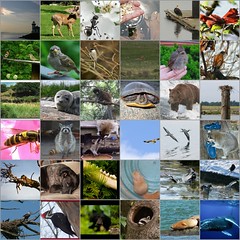
In reaching consensus around the connectivist definitions of these terms, I find myself wishing that we had more examples of networking in nature. Even so, the animal kingdom offers us many parallel words that can be translated into characteristics of 'groups':

School (fish): Whether fish or students, most schools consist of cohorts or classes who are destined to swim in unision... rogue fish or learners are less likely to thrive or survive in such an environment.

Hive (bees): Look for evidence of abundant activity, all for a common purpose.

Herd (caribou): A group driven to act in a common way for the benefit of the entire group.

Cast (crabs): When a collective takes on a large production, the organized group can achieve maximal benefits by having individual members specialize in the completion of distinct tasks.

Team (cattle): A group that works collaboratively to achieve a common goal will sometimes have members take on common roles, but might also assign distinct responsibilities based on individual expertise.

Gang (elk): Coming together intermittently, this is a disorganized group that acts reactively without need for a pre-determined purpose.

Pack (rats): Rather than acting constructively, this group attempts to 'bring down' others, rather than to contribute for the benefit of the group.

Mob (kangaroos): At times, a large group that is not formally organized, will coalesce in response to a specific catalyst.

Flock (gulls): Just as the movement in the stars/seasons caused a group of birds to migrate together, so too are distributed members of a group sometimes influenced by memes.

Huddle (penguins): This group would rather find answers from its own members rather than seek assistance or expertise from the outside.

Posse (turkeys): A group whose members have forged lasting connections over a period of time, gathers on an ad hoc basis as needs arise. Such groups are able to respond more quickly than many other groups, thanks in part to pre-existing familiarity among members.

Crowd (porpoises): A group that finds itself wanting to act after participating in a common experience such as a symposium, workshop, or presentation.

Pod (seals): Although the benefits to all members of the group are very similar, membership in a pod might be seen as more flexible, allowing an individual to be a member of more than one group.

Although I've discovered many examples of groups harnessing sameness and order to achieve collective benefits, similar parallels to the openness and autonomy of a network are more challenging to isolate. Maybe 'networking' is new to the animal kingdom; or perhaps such behaviors are learned and are indicative of higher level thinking?

I like to think that my online persona "The Clever Sheep" is an apt metaphor for the networked learner. I prefer to follow my own path, while leading others in new directions; to harness the expertise of my online peers, while contributing to the professional learning of like-minded colleagues.


Photo Credit: Yeimaya

Learning Then and Now

A conversational lesson from Stephen Heppel courtesy of the K-12 Online Conference.


I can't help but think that so much of education today, is a history lesson, with students and teachers stepping back into classroom 'museums', learning with 20th century tools, and decades-old strategies. What we need more than 21st century classrooms, is a willingness to recognize the need for a continuous evolution in learning.

How agile, adaptable and flexible is your neighbourhood school?

What artifacts are you leaving behind as evidence of the work you've done... either in teaching or in learning?


Old Rules: New Tools... a podcast reflection.

Thursday, October 9, 2008

All the Tech You Need to Know, You Learned in Kindergarten

The original book "All I Need to Know, I Learned in Kindergarten" was compiled by Robert Fulghum back when I began teaching in the late 1980's. Written to give life's lessons to adults, it was published before the World Wide Web even had a name. Taking time to reconsider Fulgham's ideas, his mini-essays are still quite relevant in the world of educational technology.

Share everything. License your work and then make it available to others. Share your passions, your ideas, your opinions, your work...

Play fair. Let others have a say, and let them contribute.

Don't hit people.
Spammers should read that one! C'mon, use your nicest voice even if you disagree with others.

Put things back where you found them. Well, how about telling others where you found things? Take time to share you bookmarks in Delicious or Diigo or another social bookmarking site. If you don't do that, at least send us a tweet when you find a gem.

Clean up your own mess.
Some might say "Read the ____ Manual"; I suggest trying to work yourself out of a jam before begging for assistance.

Don't take things that aren't yours. If you borrow or build on material produced by others, then attribute the original material.

Say you're sorry when you hurt somebody. If you err, admit your mistake and publish a correction, clarification, or retraction.

Wash your hands before you eat. And wash them after you eat; especially if you plan on using my keyboard!

Flush. Right, flush... your cache! Depending on your computer's settings, you might be holding on to gigabytes of unnecessary files. Who knows, your computer might just run a little more smoothly.

Warm cookies and cold milk are good for you.
Well, cookies do remind websites that you've visited before, and it helps them recognize you. Too many unsavoury cookies aare not good for you or your computer, so be sure that the cookies are the right kind.

Live a balanced life - learn some and think some and draw and paint and sing and dance and play and work every day some. Translation: Turn the computer off every once in a while! There is a world out there waiting for you!

When you go out in the world, watch out for traffic, hold hands and stick together. Collaborate with team members, colleagues and members of your wider network. If we engage evolving tools together, we're more likely to use them safely, productively and purposefully.

Be aware of wonder. Remember the little seed in the Styrofoam cup: the roots go down and the plant goes up and nobody really knows how or why, but we are all like that. We don't all have the answers; take pleasure in being a learner! The read/write web has plenty of magical finds to share, but we don't have to worry about knowing how or why everything is the way it is.

Goldfish and hamsters and white mice and even the little seed in the Styrofoam cup - they all die. So do we.
But your work on the world wide web will live on... make it worthy of near immortality.

And then remember the Dick-and-Jane books and the first word you learned - the biggest word of all - LOOK.
Take time to read the ideas of others. Use RSS to ensure that you have a regular diet of good things to LOOK at; and if you collect podcasts, to LISTEN to!