It's been two years since I first wrote about 'Learning Without Teachers', and now Sugata Mitra is sharing compelling stories involving peer instruction, that should lead educators at all levels to re-think what it means to teach.
Mitra's most recent research seems to validate an approach that forgoes 1:1 computing, in favour of a strategy that limits access to learning tools. In a wide range of settings, with diverse populations of learners, Mitra has married the use of communications technology to 'interest-based' learning, and the early results have been stunning, even if counterintuitive.
Do you believe that this 'peer to peer' approach affirms recent developments in professional learning? Does it validate project-based approaches to learning? Might it support equipping a classroom with an On Demand Ecosystem?
Sugata Mitra speculates that "Education is a self organising system, where learning is an emergent phenomenon..." and he is committed to researching this contention. Whether or not we agree, Mitra's work provides an unspoken challenge: How do you assess the effectiveness of the tools and learning strategies that you employ?
Showing posts with label 1:1. Show all posts
Showing posts with label 1:1. Show all posts
Tuesday, September 7, 2010

Monday, May 3, 2010
We Can do Better than 1:1 Computing: Making the Case for an On-Demand Ecosystem
The very nature of any initiative that puts matching tools into the hands of students, facilitates the teacher led, lock-step learning that many constructivist educators rally against. That's just one reason I'd prefer that children learn and grow in an ecosystem filled with a variety of rich tools, rather than being assigned to a classroom boasting a 1:1 computer ratio.

I like to see the classroom as a learning commons, where individuals can tap into a range of devices to further individual and small group inquiry. In a project-based learning environment, the need for technology should vary widely among both teacher and student learners. Why not frame a classroom around a kit of enabling devices, designing an ecosystem to support the needs of groups and individuals?
The On-Demand Ecosystem:
Hand-held Devices:
 In an ideal world, students will have permission to enable their personal devices on the school network. I would augment such an approach with shareable hand-helds, ensuring that each student would have access to e-books, apps, and cloud-based resources. While most of the apps available for the iPod and iPad are not built for rich media production, I will outline my argument for their adoption in a subsequent post. Suffice it to say, I suspect that these tools and their offspring will become the centerpiece of the learning commons.
Notebook computers:
 At the outset, I'd suggest a ratio of 1 machine for every 4 students. Beyond speaking to the collaborative nature of Classroom 2.0, such an approach would lead all to value the interdependence of learners and devices alike. As the most capable devices in the ecosystem, these shared machines would do the heavy lifting for groups tasked with digital storytelling; media development; and online publishing.
Audio tools: Microphones, headsets, and speakers should be available for recording and playback. Securing a set of devices for each notebook computer seems sensible.
Digital Cameras: Used to create raw content for later post-production, these devices would capture evidence of learning, while facilitating the emergence of wide-ranging multimedia products.
Scanner: Whether scanning documents, photographs, or artwork, the scanner would ideally be accessible by any notebook computer.
Document Camera: An opaque projector for modern times, this device is perfect for the sharing print media; screens from hand-held devices; and other 2D and 3D offline content.
Projector: Whether touch sensitive or not, this presentation device might be paired with the teacher's computer to facilitate teleconferencing and large group instruction. In providing an area of focus, it would also be leveraged by individuals, partners and groups to share their learning.
You may note that I've neglected to include a printer. What does this say about the learning commons I'd prefer to see? Am I missing anything else? Which tool you see as critical to the design of Classroom 2.0?
Photo Credits: Adam Melancon; angela.a.acevedo; Burnt Pixel

I like to see the classroom as a learning commons, where individuals can tap into a range of devices to further individual and small group inquiry. In a project-based learning environment, the need for technology should vary widely among both teacher and student learners. Why not frame a classroom around a kit of enabling devices, designing an ecosystem to support the needs of groups and individuals?
The On-Demand Ecosystem:
Hand-held Devices:
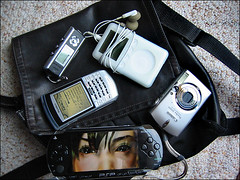 In an ideal world, students will have permission to enable their personal devices on the school network. I would augment such an approach with shareable hand-helds, ensuring that each student would have access to e-books, apps, and cloud-based resources. While most of the apps available for the iPod and iPad are not built for rich media production, I will outline my argument for their adoption in a subsequent post. Suffice it to say, I suspect that these tools and their offspring will become the centerpiece of the learning commons.
Notebook computers:
 At the outset, I'd suggest a ratio of 1 machine for every 4 students. Beyond speaking to the collaborative nature of Classroom 2.0, such an approach would lead all to value the interdependence of learners and devices alike. As the most capable devices in the ecosystem, these shared machines would do the heavy lifting for groups tasked with digital storytelling; media development; and online publishing.
Audio tools: Microphones, headsets, and speakers should be available for recording and playback. Securing a set of devices for each notebook computer seems sensible.
Digital Cameras: Used to create raw content for later post-production, these devices would capture evidence of learning, while facilitating the emergence of wide-ranging multimedia products.
Scanner: Whether scanning documents, photographs, or artwork, the scanner would ideally be accessible by any notebook computer.
Document Camera: An opaque projector for modern times, this device is perfect for the sharing print media; screens from hand-held devices; and other 2D and 3D offline content.
Projector: Whether touch sensitive or not, this presentation device might be paired with the teacher's computer to facilitate teleconferencing and large group instruction. In providing an area of focus, it would also be leveraged by individuals, partners and groups to share their learning.
You may note that I've neglected to include a printer. What does this say about the learning commons I'd prefer to see? Am I missing anything else? Which tool you see as critical to the design of Classroom 2.0?
Photo Credits: Adam Melancon; angela.a.acevedo; Burnt Pixel
Thursday, April 23, 2009
Top Ten Benefits of Handhelds in the Classroom

One-to-One computing is already here, it's just that we can't experience it on a large scale, until we accept the validity of cell phone technology in the classroom. Here are just a few examples of the potential of this micro-computer technology, should we allow students to bring wifi enabled mobile communicators to school:
1] Photography: Students will leverage cell phone cameras to document science experiments; to create photo essays; to archive learning experiences...
2] Cloud Apps: Wifi enabled cell phones will provide access to instant news; collaborative wikis; and a wide variety of other web-based documents. What's more, access to documents will allow both reading & writing.
3] Synchronous Audio: Whether linking with classmates; or connecting with relevant real world experts, the potential for free communication via Skype and other wifi services will further erode classroom walls.
4] File-sharing: Savvy teachers will engage personal computers as Bluetooth servers to automate the delivery of text, audio, and mixed media content to student hand-helds. For examples of the potential for this technology, visit Jarrod Robinson's blog.
5] Geotagging: As global positioning technology (GPS), becomes common on mobile phones, it will be used to post text, audio and photo content with automatic tags to geographic locations. Partnered with Quick Response codes (QR tags) the resulting cloud content can be drawn to hand-helds through the snapping of photos.
6] Podcasting: Recent studies are demonstrating the value of recordings to student learners who are growing up in a world of random access. With the potential for retrieving content produced by both students and teachers, the use of portable audio as a universal design for learning, is long overdue.
7] Streaming: Besides allowing handhelds to view streaming content, apps on the iPhone and other modern mobile phones, now allow live audio and video broadcasting. Classroom channels will soon share learning with parents and other interested community members.
8] Tweet-notes: Two-way Twitter feeds now available via mobile clients, can connect students to students; classrooms to classrooms; teachers to teachers. Realizing that text message conversations provide opportunities to save, share and search ideas, we may soon be using Twitter Search as often as we use Google.
9] Learning Through Gaming: Video game producers have been slow to meet educational needs with their hand-held devices, but Flash-based learning activities are becoming ubiquitous on the wider web. As mobile browsers evolve to represent this content, every classroom will have open access to engaging learning apps.
10] The World at Hand: The day's global news; electronic libraries; and user-generated content will be available to each student. With the sum of all human knowledge in the palm of the hand, educators will be forced to address issues of validity and bias, and will have to re-think how students can demonstrate their learning. I for one, await the advent of the open phone test!
What other educational changes can we expect, once we welcome mobile phones in the regular classroom?
Photo Credit: Jason Jerde
Subscribe to:
Posts (Atom)