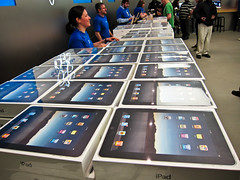
The iPad
comes to Canada and other international destinations on May 28th. Whether or not educators will line up to get them, there is little doubt that the new 'tablet category' of handheld devices will spark plenty of debate in both staff rooms and living rooms. In case you find yourself in conversation about the relevance of the iPad, consider the following issues as fodder to further the discussion.
The Entry Point We've Been Waiting For?I would argue that the iPad is the perfect entry point for educators who have, until now, avoided the implementation of modern communications technologies. But guess which folks have been snatching the first available tablets? The tragic conundrum from my point of view, is that the very people who would most appreciate the iPad's simple interface, have been loathe to follow early adopters, let along elbow them out of the way to purchase the latest tech gadget.
The iPad in partnership with an expanding catalogue of intuitive apps, provides a user-friendly entry point through multi-touch. Maybe it
is reasonable to expect every teacher to be able to use a computer?
Simple MattersThe complexity of computer programs and peripheral devices have has always been a significant barrier for the widespread adoption of communications technologies in education. With the removal of input devices (i.e., no keyboard; no mouse; no disk drive; no usb drive; no power cord...) I'm betting ICT novices will be happy to let their fingers do the walking.

Even the greasy fingers of very young students are sure to be attracted to the bright colours and interactive apps. As we add these tools to primary classrooms, I hope we'll include comfortable '
learning mats', allowing little ones to share their learning in more ways than one.
Consumption vs CreationThe iPad in its present form, has limited tools for creating content; but is an incredible device for consuming content. As a new category of device, can we really expect it to be a 'swiss army knife'?
I agree with Trevor McGarrah, who writes at
Edutechnophobia that taking real notes with a stylus would be a great way to leverage the touch-sensitive screen.
Mark Crump suggests that the ability to take a photo into notes would be a bonus. Others might suggest that microphones, VGA output, or disk space should be priorities. Do you see these otherwise common tools as necessary steroids for this new tool?
Beyond the expandability, there is a practical need for teachers to be able to easily and quickly clone the contents of a given iPad. Being able to streamline the updating of apps, e-books, activities, presentations, or bookmarks will ensure on-demand readiness. Ideally, a simple solution will allow a teacher to simultaneously update multiple devices to a common iTunes account; or to push content to a number of iPads. Is
Apple working on this yet?
Books Are Changing
In the future, most every book is sure to be available electronically. Those published on paper, will embed hyperlinks and
augmented reality upgrades. If you've seen '
Alice' or '
The Elements' you should have an inkling of what is possible on this new platorm.
Having spent 5 minutes with a
Marvel comic book on the iPad, I can honestly say it's the most engaging bit of reading I've ever done. Tactile, kinethetic, and visually compelling, books on the iPad will redefine what it means to be an active reader.
Not Ready for e-Books?! This past week,
Dalton McGuinty, Ontario's premiere,
shared his opinion on e-books:
"I think that over time we are probably going to make a transition to more technology-based reading and learning for our students, but my fear is that at this point in time it may be a little premature..."
There are few tools that education has been the first to adopt, but I can think of two: the
chalkboard; and the
e-chalkboard. Many believe that we should be stepping more boldly into electronic textbooks, while I'm of the mind that we should be
writing our own.
A Presidential ObservationSpeaking at Hampton University, the president of the United States is
quoted as saying:
"With iPods and iPads; Xboxes and PlayStations -- none of which I know how to work -- information becomes a distraction, a diversion, a form of entertainment, rather than a tool of empowerment, rather than the means of emancipation" Obama said.
With brains tending more and more to be wired for attention deficit, my vote is that we find ways to make use of emerging tools, rather than dismissing them out of hand. I'm hopeful that a more relevant curriculum is on the horizon; one where students will learn to write, edit, and publish authentic products including touch-sensitive apps. Maybe we should ensure learners use tools that remind them that their world is destined to be very different than ours?
A Learning WindowWhile most of the apps available for the ipod; iphone; ipad are not built for rich media production, I suspect that in short order, learners will see the device as what Lucas Gillispie calls
a learning window.
Although initially, the iPad may be reminiscent of 'one-way glass', an ever-expanding menu of applications are sure to bring new uses to light. My biggest worry, is that too many of the educational apps for iPad will be written by yesterday's learners, focusing on developing the drill and repetition skills of a bygone era.
High TouchRich tactile experience as made possible via multi-touch, are sure to influence the way we interact with yet unimagined devices. If indeed interactive whiteboards are effective because they provide users with right-brained, high touch experiences, can you imagine what will result when each learner is afforded such opportunities in their daily work?

It's been over 100 years since the original chalkboard led schools to adopt individual slate tablets, maybe iPads are a logical next step?
Researchers in PracticeWhile Michael Trucano has highlighted a number of
worst practices in ICT use in education, a few are worth considering before launching into an iPad rollout. I don't agree that technical training should be necessary for such an intuitive device. Rather, leaders should model how a tablet device might be leveraged in day-to-day learning. If we're serious about ensuring that educators are comfortable with new tools such as the iPad, why don't we offer programs like
"summer vacation with the tool of your choice"?
The most tranformative point Trucano hints at, is that educators ought to see themselves as researchers, comparing and contrasting the effectiveness of tools and strategies. Even allowing for what Michael Fullan, in "
Leading a Culture of Change" would call an
implimentation dip, documenting the results of pilot projects, and reflecting on learner experiences, should be of the highest priority.
One Part of a Larger EcosystemAs
I've written before, I'm not a supporter of each student having the same device. My vision is of a classroom is one where students and teachers are supported by a range of devices, any of which might be made available for 'just-in-time' learning. While the classroom ecosystem will include ipads, notebook computers, cameras, ipods, and other mobile devices, it will take a special teacher to recognize how these tools can be leveraged to achieve specified learning outcomes.
I agree with
Wandering Academic who suggests “
Tablet schools” are the new laptop schools, and they are imminent." My hope is that schools will recognize the iPad and similar tools as key components of an ever widening menu of learning tools.
With over
one million iPads sold in the first month, this app-happy device is proving to be extremely popular with those lucky enough to get their hands on. Just ask
Chuck Hollis who recently reflected on "
What iPads Did to My Family".
It's Not About the Tool... Unless It IsChange is not about the tools, it is about having a mindset that re-imagines classrooms as flexible, collaborative learning environments. Once we have such a common understanding, we will naturally adopt devices like the iPad, a tool that
Tony Bradley and others recognize as "
...a device built for mobility... an ideal platform for working with the cloud."

Whether the next tool we consider is a touchscreen device like the rumoured
Hurricane from HP; a
Google tablet; a revolutionary mobile phone; or some yet unimagined device, we should be on the lookout for tools that empower learners to take control of their own learning. I think that the iPad holds such promise.
Photo credits: bump; aperturismo; anitakhart; The Shifted Librarian; Caro's LinesJason Nicholls

 Many of our colleagues liken the makeover of our education system to the steering of a large 'directionally challenged' ship. Taking a different tack, I like to consider our educational system as being analogous to an iceberg. With little doubt that we are in the midst of global climate change, the iceberg's very existence is under threat. Understanding that accelerating change that is real in every other facet of society, surely we can conclude that the modern understanding of school, is similarly at risk.
  Educators in this social learning space, are attuned to messages about engaging project based learning; leveraging social media; and ensuring that students 'own the learning'. But these messages fly against the comfortable anchor of daily lessons that over many years, have become the frozen foundation of our practice. Rebel educators have always been leaping from the crest of the berg, furthering their own learning in the quiet and lonely crevices provided by the unseen surfaces of our iceberg. Maybe by way of slow drip, we can lead colleagues and students to consider exploring these new worlds? Maybe we need to polish the smoothest portions of the iceberg, revealing the many innovations that are taking place below the surface?
  In the end, it is that unseen part of the iceberg, where innovators test the limits of today's learners, that will lead to a course correction for that steamship that everyone seems so intent on 'turning around'. What are you waiting for? Sound the alarm by pointing your colleagues to a blog post, a video, a podcast. You've just been drafted as the look-out in the crow's nest.