Sunday, April 11, 2010

10 Things I Learned at TEDxOntarioEd

As a member of the team that brought TEDxOntarioEd to life, I've been privileged to follow the reflections of participants throughout the weekend. As much as we were able to learn from the motivated lifelong learners who took to the TEDx stage, the lessons I learned were in the process as much as the product.

1] Brand Magic:
When you run an event associated with TED, you are far more likely to engage top notch talent. In our case, we were blown away by the quality of speakers who participated in our event at no cost.

2] Pushing Pixels:
In taking the lead on the LiveStream broadcast of our event, I discovered that pixels go to incredible places; like a prim on cedar island in SecondLife.

3] Creativity Matters:
When educators (and students) get opportunities to create for a real audience, they often do their most amazing work. As evidence, consider the set props, food, and public speaking each of us experienced.

4] Glitches are Part of the Story:
In leveraging computers; remote Adobe Connect feeds; digital video cameras; microphones; presentation media; multi-point lighting; video switchers; monitors; sound boards; and video production software, hiccups were almost guaranteed. Being open and honest with our audience was one way to model the risk-taking that we encourage among educators far and wide.

5] Social Matters:
In his reflective response to TEDxOntarioEd, Graham Whisen's calls it "The New Knowing" and highlights many of the reasons we encouraged remote participants to host satellite viewing parties for the event. Aviva hosted one of these events and writes about a transformation we couldn't see.

6] Support = Trust:
The London District Catholic School Board, (my home board) entrusted us to an amazing site, and a wide range of technology. Colleagues from Building Services, the ICT department, and Program Department, each contributed their time, talent and attention. Trust on the part of many individuals made it all possible.

7] It Begins and Ends with Students:
Our culminating speaker's talk will soon hit YouTube. My prediction is that it will outdraw all of the other talks from April 9th. Change happens when educators can commit to addressing the real needs of learners; and when an 'at risk' student captivates an audience to set us straight, you can't help but pay attention.

8] The TED Divide:
Those who were on hand, 'get' TED; and were likely to have pre-exisitng professional learning relationships with other attendees. Many of those who dismissed our invitation to attend, did so without prior knowledge of TED, and may yet be unaware of the power of personal learning networks. The buzz at our event was due in large part, to the fact that the majority of attendees were on the same side of the divide.

9] TED is a Global Phenomenon:
LiveStream analytics tracked over 800 unique online viewers. As expected, Canada and the USA had the most participants; with Australia, the United Kingdom, India, Brazil, Mexico, Chile, Portugal and the Netherlands each having at least 12 unique viewers.

10] It Takes a Team:
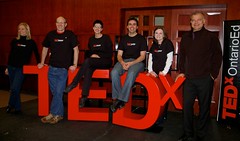
A tight group representing a number of different regional school boards, pooled their collective talents to bring TEDxOntarioEd to life. Planning meetings took place via Skype, so Friday evening was the only time we'd actually been together in the same place. The result was one of the most challenging and affirming projects I've ever been associated with. Without a doubt, I'll be looking for future opportunities to work with Ben Hazzard, Jamie Weir, Sharon Drummond, Kim McGill and Colin Jagoe.

If you are interested in seeing or hearing what others have to say about TEDxOntarioEd, I've been tagging photos and related blog posts at http://delicious.com/thecleversheep/tedxontarioed

Photo Credits: rosefirerising and the TEDxOntario photo team

Wednesday, April 7, 2010

TEDxOntarioEd: What Motivates You?

To say things have been busy, would be an understatement. Between preparing students for the Ontario Secondary School Literacy Test; putting the wraps on my Special Education full-distance teaching responsibilities; and preparing for TEDxOntarioEd, something had to give.

Each of these projects wraps up this week, so I should be able to get back into publishing my personal and professional discoveries via blog posts and podcasts. Until then, I'm happy to invite you to join us on Friday, April 9th, when, live from London, Ontario, my colleagues and a wide range of motivated presenters, will breathe life into TEDxOntarioEd.


We're encouraging remote participants to connect to our TEDx event by watching with other lifelong learners. Together we can make connections that dissolve the limits of time and space.

I'd encourage you to check out the biographies of our diverse line-up:

6:55 TEDx Intro Video
7:00 Welcome: Rodd Lucier
7:05 Dan Misner
7:10 Paul Finkelstein
7:20 Ray Zahab
7:35 Lee LeFever
7:45 Joey Savoy
7:55 Zoe Branigan-Pipe
8:05 Tim Long
8:15 TEDx Video
8:20 BREAK
8:40 TEDx Video
8:45 Robert Martellacci- MindShare Learning
8:55 Danika Barker
9:05 Nathan Toft & Jane Smith
9:15 Jesse Brown
9:30 Alec Couros
9:40 Kathy Hibbert
9:50 Tim – Student

Are you a novice teacher? An expert? Someone considering entering the field of education? As long as you are open to learning, this event can serve as 'welcome (back) to the profession'. We hope you'll consider joining us via Livestream to consider 'ideas worth spreading'.

Monday, March 22, 2010

Google Streetview & Augmented Memory

A week ago, Doug Peterson shared a highly personal, reflective post: My Childhood Community. While Doug's blog is always informative and thought-provoking, this one has created more ripples than he likely imagined.

Like many others, I have frequently dragged the little yellow dude onto a map in Google Streetview, but I hadn't done so through my 'little kid' eyes. What I discovered took me on an emotional ride that is sure to continue. Let me just share a few highlights from earlier this evening.

A virtual visit to what will always be for me, the home of my granparents, sent me to reconsider a tree that was gnarled and gigantic in my youth; to reminisce about playing with the large-grated air vents in the upstairs bedroom; to reflect on my grandfather's habit of listened to Tiger games on the radio, while simultaneously watching a game or two on television.

And that thought sent me to Tiger Stadium. Though it no longer stands, the glow of the stadium at nighttime was a common spectacle from downtown Windsor... so Google Streetview beckoned.

Most images in Google's cache still show the home plate quarter of the stadium, but this one photo was taken another day, after the camera car had completed the Michigan-Trumbell-Cochrane loop. This image captured the fall of the Ernie Harwell's booth and the best seats in the house, while a proud flag waved from the centre field flag pole!

My inner conversation let me next to consider the two most significant sports fields of my youth. The first was the street in front of my house that was home to road hockey, street football, and kick the can.

The other, was the school down the road where I learned to run track, play basketball, and work on my short game on our custom par three golf course". The most surprising memory trigger for me, was the pole that now sits outside of the school playground. It marks the spot where we played tag games like British bulldog, and where hero pranksters opened the fire hydrant to flood our schoolyard for winter skating. It's also where the Duncan Yo-Yo man wowed us with tricks and hooked us on what was to us, a brand new toy.

The details of my memories may be of little interest to others (including my own children), but to me, the memories are priceless. And the detail and pace at which they came flooding back was surprising when inspired by modern day digital images.

But I'm late to the party!

Shortly after My Childhood Community appeared, Stephen Downes contributed Where I Grew Up, a reflective post very similar in flavour to Doug's post.

A few days after that, Megan Palevich posted A Walk Down Memory Lane with Google Streetview. After embracing personal memories with her mother, Megan took the idea a step further, considering how students and teachers might embrace this idea.

The lesson she developed was later shared with Zoe Branigan-Pipe whose reflection highlights what for me was the biggest story in the experience... the great value we can discover in sharing our ideas with other networked teacher-learners.


Doug Peterson started more than a meme. He set memories in motion; initiated creative storytelling; inspired collaborative networking. Now that he's posted An Idea that Keeps Growing, you can take your digital time travel to new levels.

As a first step, reward yourself with an augmented trip through your own memories.

Sunday, March 21, 2010

Siberian Express: Mission Accomplished


Ray Zahab and Kevin Vallely have crossed Lake Baikal!

Running daily marathons would be incredible enough, but they've done it while toting provision-laden sleds through high winds; in arctic temperatures; across rugged frozen terrain. The Impossible2Possible team made the journey in just over 13 days, and in doing so, inspired thousands of students who followed the expedition.

In just a few weeks time, Ray will be joining us as a live speaker at TEDxOntarioEd. To say we're exited, would be an incredible understatement. To see what they endured, visit Impossible2Possible, or check out this video summary of the expedition:

Siberian Express Wrap-Up from GOi2P on Vimeo.

Tuesday, March 9, 2010

It's time for Educators to "Pay Attention"

If the ideas you are about to hear are new to you, it's only because you haven't been paying attention. Voices scattered across the edublogosphere have been saying these things for some time. Maybe it just rings more true when a youthful learner says it?


Did you catch the sheep doing cartwheels at the end of this video?

Wednesday, March 3, 2010

Roger Ebert Speaks

Last week, I had the good fortune of stumbling across 'The Essential Man' an Esquire article that reconnected me with storied film critic, Roger Ebert. The article prompted me to locate Roger Ebert's online journal, where he seems to be saying more than he ever did 'from the balcony'.

As much as I'm glad to see this man's passionate commentary in text, this morning, I learned that Roger Ebert can now communicate using synthesized audio built from samples of his own voice. To find out how this is possible, listen to Dr. Matthew Aylett, chief technical Officer at CereProc as he explains the technology on NPR's All Things Considered.


Voices in School
While we don't have access to Ebert's voice, staff and students in my district are coming to realize that they can leverage a range of voice-augmented assistive technologies including a talking word processor. In a workshop today, for a combined group of staff and students, my colleague Pat Hammond, introduced many of these Premier literacy tools. My interview with Pat, is episode #219 of the Teacher 2.0 podcast:


I suspect it won't be long before we see personal digital language assistants adopted as universal designs for learning.

Photo Credit: .m.e.c.