Showing posts with label education. Show all posts

Friday, April 26, 2013

UnPlugd13: Fuel Your Passion

Who: Educators and their families
What: A summit for educators interested in making meaningful connections with colleagues while pursuing a wide range of creative and recreational pursuits.
When: August 5-8, 2013
Where: Northern Edge Algonquin
Why: Because we’re worth it!

Over four days and three nights, you will interact with kindred spirits who long to share stories and ideas amidst the natural splendor of Algonquin park.  You’ll be amazed at the meaningful connections you can make in an off-the-grid setting.

Whether your yearn to engage in rich conversation; to dive into uniquely Canadian recreation; or to dine on nutritious and delicious meals, you’re sure to find the unplugd13 experience to be rejuvenating in ways you’ve never imagined.

UnPlugd13 is limited to the first 40 participants, so if you are at all inclined to join us, visit the registration page while space is still available.

Learn More:
·       If you’re not yet familiar with the concept of learning and relaxing in an unplugged setting, consider visiting UnPlugd.ca, or review photos and reflections of recent participants.
·       Follow past participants via #unplugd11 or #unplugd12.
·       Feel free to connect with me via phone, email or video conference.
·       Join in on the pre-event conference call for registrants.

Wednesday, August 17, 2011

The Process is the Product

There were many ‘A-Ha’ moments in the lead up to UnPlug'd, but the tipping point to the event, was the decision to revisit collaborative publishing. The publishing of one’s own words, refined to sit alongside the ideas of passionate peers, would become the pinpoint focus for our time at the Edge.
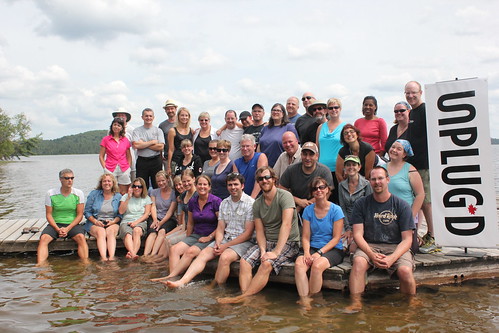

The resulting product, which is being released one chapter at a time over the next 6 weeks, is a book that encapsulates many of the things that participating Canadian educators think matter most. While you would think that bringing tech-savvy educators together to tell stories, and to think, and to share might lead to discussion about the latest technological tools, there was nary a mention of Google+ or any other emerging tool. The weekend was about connecting and learning.

Our book title: “Why ___________ Matters” gave each participant the opportunity to fill in the blank. This differentiated writing and story-telling task led to the exploration of a wide range of topics that resonated through the passionate participation of delegates. None-the-less, our collaborative book will leave many unconsidered ‘blanks’ including:

Why imperfection matters;
Why commitment matters;
Why stories matter;
Why authenticity matters;
Why healthy choices matter;
Why risk-taking matters;
Why circles matter.


UnPlug’d was intentionally structured to engage participants in increasingly personal conversations, that in the end led participants to share stories and writing that would make possible the end result: a book. By traveling together, dining together, singing together, paddling together, washing dishes together, doing yoga together, watching the night sky together, we became a more tightly knit tribe.

In a following post, I’ll be writing about the flexible but carefully structured ‘lesson plan’ for UnPlug’d, but there is one big, big thing I’d like #unplugd11 participants to consider: How can you bring similar community building experiences to your classroom in the coming school year?

Will you make time to share personal stories?
Will your classroom leverage 'circle-ness'?
Will you embrace opportunities to share healthy food together?
Will you model and support risk-taking?
Will you foster an environment that harnesses individual accountability to the group?
Will you be fully attentive to the needs of colleagues and students?

Will you build community through ordinary actions, in order to create an extraordinary learning environment?


Photo Credits: Andy Forgrave, Northern Edge Algonquin, Bryan Jackson

Tuesday, March 1, 2011

UnPlug'd: A Canadian Education Summit

Going to the 'edge', and taking the leap to try something that's never been done before, can be both intimidating and energizing at the same time. Taking such a risk with friends is one way to give yourself the guts to attempt even the most challenging of endeavors. I count myself lucky to work with colleagues who share a common dream; one that will breathe life into a potentially transformative teaching and learning experience.

In August of 2010, I found myself immersed in the natural setting of the aptly named Northern Edge Algonquin, a retreat centre near South River, Ontario, and I asked myself:

"What would happen if we could gather together innovative educators who were used to 'learning out loud'? How might Canadian thought leaders interact in a face-to-face environment? What might such teacher-learners create while immersed in a natural setting, 'unplugged' from the online world?"


When the questions refused to fade upon my return home, I made phone calls to a few kindred spirits I'd come to know and trust. After conversations with Zoe and Ben, I sketched out a plan for a meeting that would include Alec and Dean, two distant Canadian colleagues whose vision for collaboration and sharing are well known. And now, six months after our initial meeting, our team includes Tom, Darren and Bill, and we've gone public with "UnPlug'd", the first grass roots Canadian education summit.

UnPlug’d will take place this summer, bringing 40 leaders from classrooms across Canada, to the remote retreat setting of Northern Edge Algonquin. At a carefully orchestrated 3 day summit, teacher-learners will share their most compelling stories, and will refine a shared vision about what really matters most in K-12 education in Canada. In the wake of the summit, we will capture and share our collective wisdom in a mixed media publication: "Why _______ Matters".


Will the thin electronic ties among delegates be thickened through face-to-face familiarity? Will we be able to collectively re-imagine what it means to be a teacher? Can a Positive Deviance approach to social change, lead the transformation of education?

Regardless of the outcome, a number of Canadian educators who are already re-inventing education, are going to have some wonderful stories to tell. In fact, it's a story Ben and Zoe have already begun to tell.

Photo Credit: Rodd Lucier (taken at Northern Edge Algonquin)

Monday, December 6, 2010

Ontario Edu-Bloggers Please Stand Up

I recently discovered Chris Kennedy's blog, Culture of Yes, after watching his talk at TEDxVancouver. In his most recent post: Buy Local, Chris identifies edu-bloggers from his home province. In so doing, he can't help but wonder why so many voices seem to be centred in and around Coquitlam.


In the hope of inspiring more teacher-learners to share their opinions, experiences, and ideas, I feel compelled to do what I can, to introduce provincial colleagues to as many local teacher voices as I can. The first step, is finding Ontario teachers who blog:

Wednesday, April 7, 2010

TEDxOntarioEd: What Motivates You?

To say things have been busy, would be an understatement. Between preparing students for the Ontario Secondary School Literacy Test; putting the wraps on my Special Education full-distance teaching responsibilities; and preparing for TEDxOntarioEd, something had to give.

Each of these projects wraps up this week, so I should be able to get back into publishing my personal and professional discoveries via blog posts and podcasts. Until then, I'm happy to invite you to join us on Friday, April 9th, when, live from London, Ontario, my colleagues and a wide range of motivated presenters, will breathe life into TEDxOntarioEd.


We're encouraging remote participants to connect to our TEDx event by watching with other lifelong learners. Together we can make connections that dissolve the limits of time and space.

I'd encourage you to check out the biographies of our diverse line-up:

6:55 TEDx Intro Video
7:00 Welcome: Rodd Lucier
7:05 Dan Misner
7:10 Paul Finkelstein
7:20 Ray Zahab
7:35 Lee LeFever
7:45 Joey Savoy
7:55 Zoe Branigan-Pipe
8:05 Tim Long
8:15 TEDx Video
8:20 BREAK
8:40 TEDx Video
8:45 Robert Martellacci- MindShare Learning
8:55 Danika Barker
9:05 Nathan Toft & Jane Smith
9:15 Jesse Brown
9:30 Alec Couros
9:40 Kathy Hibbert
9:50 Tim – Student

Are you a novice teacher? An expert? Someone considering entering the field of education? As long as you are open to learning, this event can serve as 'welcome (back) to the profession'. We hope you'll consider joining us via Livestream to consider 'ideas worth spreading'.

Wednesday, February 10, 2010

What does Quorum Sensing have to do with Me?

I admit it, I'm hooked on learning. I get a rush when I discover something new, especially if it's something known to relatively few people. Today, I learned about Quorum Sensing, and a whole lot more, from the behavior of bacteria.

Bonnie Bassler's hyper-enthusiastic TED Talk from one year ago, is focused on bacteria and bio-chemistry, but if you pay attention, she weaves many lessons into her talk.


Prone to thinking metaphorically, I'm left wondering how our own networked learning might one day lead us to collectively shine our light, to brighten the paths of tomorrow's learners. Is it possible for the online ed-tech collective to enlighten our 'hosts'?

Wednesday, January 20, 2010

Learning to Change: Changing to Learn

I'm hopeful that the realities expressed in by the luminaries in this short piece will open a few more minds. Here's to the death of Education; and the dawn of Learning:

Thursday, November 26, 2009

My Edublog Nominees

For the past few years, the Edublog Awards have been very effective at highlighting a wide range of blogs across the educational spectrum. Last year, I only came to learn about these awards by being nominated in the Tech Support category, and while I voted for my favourites last year, I'm ready to make nominations this year.


Best Teacher Blog
Mr. Robbo's Blog: Jarrod Robinson is a teacher-learner-experimenter in his second year of teaching, who models lifelong learning. Jarrod comes to teaching with a specialty in physical education; and he uses his blog to highlight the many innovative ways he's managed to tap into the technological interests of his students. Jarrod is proof that the future of our profession is in good hands, and if you give his blog a read, you'll realize that there are many ways kinesiology specialists can make use of communication technologies including video games; Bluetooth-enabled devices; MP3 players; QR codes and much more.

Best Individual Blog
Off the Record: I came to blogging the same day as my colleague Doug Peterson, whose blog is unsurpassed at humanizing the ed-tech experience. Passionate about leading others to share their learning, Doug walks the talk by publishing his reflections, observations, and personal growth experiences on a daily basis. If you know of an educator new to using communcations technologies, they'll find affirmation in the public learning Doug does... 'on the record'.

Best Class Blog

Pipe Dreams: Zoe Branigan-Pipe has only been blogging for the last year or so, but her classroom site highlights the potential of public learning. On the site, you'll find everything from student podcasts and blogs, to best practices in classroom education. As a class blog, the site demonstrates how teachers and learners can engage a range of communications tools to reach through the walls of their classrooms.

Best Educational Wiki
Open Thinking Wiki: As an open teaching advocate, Dr. Alec Couros has led the compilation of resources on a wide range of topics. Although the content is intended to support his work with post-secondary candidates, this wiki is filled with nuggets that should be of interest to any modern educator. Whether considering social justice, media literacy, digital storytelling, or copyright, visitors will find links, videos and slidedecks sure to enrich personal or professional learning.

Best Individual Tweeter
@courosa: Yes, it's the same Alec Couros. Whether tweeting from the airport, the back of an ambulance, or his classroom, Alec is always sharing relevant and interesting content. He regularly engages in give-and-take with colleagues from around the globe and at the very least, his tweets inspire followers to think, to share, and to learn.


That's my take, what's yours? Which edubloggers, podcasters, tweeters are most effective at inspiring your professional learning?
To make your nominations, simply record your preferences in a blog post that links to the Edublog Awards. Then share the link to your post on the Edublog home page. (Thanks to Sue Waters for reminding me about Step #2)

Thursday, November 19, 2009

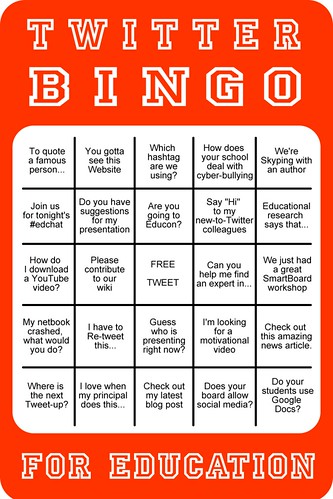
Twitter Bingo

Earlier today, I found myself reflecting on the variety of positive professional interactions I've had on Twitter in recent days. As an illustration of the great many ways an educator can put Twitter to use, I've just created a mock-up of Twitter Bingo for Education.


Originally meant to let non-Twittering teachers understand what goes on in the Twittersphere, you might want to try this challenge yourself: Print a card, and see how long it takes you to fill it, based on the edu-tweets you follow.

Image Credit: Rodd Lucier

Sunday, September 27, 2009

Great Destination


great destination by =henryz on deviantART

I love this image. To me it evokes a fantastic sense of unbridled creativity. Although the artist didn't willingly create a vision for education, let me unpack the scene as I see it...

On the whole, this place appears to be more about creation rather than regurgitation. Do we encourage our charges to learn with the intent of improving their own world?

Although the buildings do appear to be the destination, the learner appears to expect to do his work as a part of the larger natural environment. How do our learning environments expose learners to exploration and creation in the real world?

This young person appears to arrive of his own accord. Perhaps he senses his responsibility for designing his own future. What can be done to lead learners to see such purpose in their own daily work?

A vast range of tools for creation (including an iPod) are at the disposal of this young person. Are such tools readily available to our own students; and are they supplemented with modern digital tools?

I appreciate the fact that the lone chair in the scene sits empty. Which changes to your daily routine might lead students to work in settings beyond such uncomfortable chairs?

What makes your school or classroom a 'Great Destination'?

Tuesday, May 12, 2009

Chasing the Horizon

I've been thinking about how educators are consistently challenged to arrive at ever elusive end points. New tools, new expectations, new technologies... all of the newness that continually refreshes education, reinforces the fact that we will never have a final template on which to anchor education.

The best we can do, is realize that the place we now stand, is not good enough... we have to choose a direction and start heading for the horizon.

Upon arrival at a destination, leaders in education need to reassess their situation; to realign themselves; and to head towards new distant horizons.

In times of continual change, each of us is called to embark on a non-stop voyage. How will you decide which distant horizons are most worthy of exploration?


Photo Credits: Terje Enge, noinkstains

Thursday, May 7, 2009

Lighting the Fuse on Education's Big Bang

My nominee for Education's 'Big Bang', is an open partnership among hand-held computers; smart phones; data projection; and wireless networking.

Everyone in education seems to be in agreement that a significant change is necessary to ensure that learning remains relevant for future citizens. What no one seems to know, is:

What will be the catalyst that will launch schools into the future?


10 Reasons to light the fuse on networked mobile devices:

1] The tools for this change everything exist today... and at reasonable cost!

2] Wireless networking & data projection are cost effective, commonly understood connectors.

3] We can harness the ubiquitous hand-held devices that are already in kids' backpacks.

4] The rise of netbook computers is bringing the $100 laptop closer to reality.

5] Cloud computing is now a 'concrete' reality.

6] Student populations are eager for the adoption of the tools of their generation.

7] The number of teachers with an appetite for learning with modern tools continues to grow.

8] Whether using Skype, or USTREAM.tv, free two way broadcasting allows educators and students to leverage connections with classrooms around the world.

9] An expanding range of open source projects is providing a no-cost platform for creativity.

10] The blogosphere is awash with successful models for networked learning. In effect, we've written the textbook on how to embed the teaching of technology skills into performance based learning experiences.

The threat of viruses and the desire for network security seem to be the main concerns voiced by unyielding ICT departments, and though these concerns are valid, we are at a far greater risk of alienating entire learning communities by ignoring readily available tools, and restricting access to what many take for granted in their own homes, or at the local coffee shop.

The day that schools open their networks for sign-on by the devices used every day by students, parents and teachers, will be remembered as the birthday of Classroom 2.0. What will you do to help light the fuse?

What do you think? Can handheld devices help schools launch us into wondrously diverse learning experiences? Do you have another nominee for Education's 'Big Bang'?

Photo credit: pshutterbug/Prabhu

Thursday, March 12, 2009

Some Things Never Change...

Facing the realities of today's digital world, print journalism, music, and television are all evolving to meet the demands of their increasingly tech savvy audiences. Newspapers, musicians and media producers have all had to adapt to the social realities of a hyper-connected world.

Today's podcast considers how educators might similarly adapt, to ensure their own academic relevance. Real change begins through thoughtful conversations...


Social Media is Here to Stay... Now What? by Danah Boyd
10 Ways Newspapers are using Social Media to Save the Industry

Wednesday, January 28, 2009

Creative Commons: What Every Educator Needs to Know

Whether you want to find content; to license your own work; or to engage students in licensing their own work, there are many good reasons for educators to learn more about Creative Commons.


Sites referenced in this slideshow:

Creative Commons
Big Buck Bunny
CCMixter.org
Flickr
Blip.tv
Internet Archive
Craphound.com
PICOL.org
WhiteHouse.gov
opsound
Compfight, Flickr and the Creative Commons
Quick Start Tips for New Flickr Users

Wednesday, January 14, 2009

Lessons for Educators from Michael Wesch

In this brief interview, Michael Wesch of Kansas State University, affirms many of my personal beliefs about teaching and learning. In less than 10 minutes, he reminds us of the importance of collaboration; of the critical role played by modern learning tools; of the empowering nature of engaging questions; and perhaps most importantly, that teachers can demonstrate respect and love for their students.

Since first caming to my attention courtesy of "The Machine is Us/ing Us", Michael was recently recognized as Professor of the Year: Outstanding Doctoral and Research Universities Professor.


If his Michael's words ring true to you, you may also be interested in reading his Passion for Teaching Statement.

Thursday, November 20, 2008

Does Education Need to Change?

George Siemens' recent post makes me smile:

"As a small research project, I’d like to ask people to answer the following questions (on their blog, in YouTube, Seesmic, or wherever - please post a link in the comments section below):

1. Does education need to change?
2. Why or why not?
3. If it should change, what should it become? How should education (k-12, higher, or corporate) look like in the future?"


I’ve been engaging in dialogue with my PLN about these questions for the past few years and I’m still nowhere near completing my response!

None-the-less, I'll assume this is a point form test, and that there is only one slim blank line below each question. Here are my responses:

1. Yes.

2. Because most present day educational practices are irrelevant, addressing expectations for previous generations, while failing to prepare students for what promises to be a very different future.

3. Education should foster the evolution of a diverse menu of learning experiences. Classrooms should be flexible environments able to adapt to the needs and interests of an increasingly connected student body.


Care to respond? Feel free to add your thoughts below. If you choose to make a blog post of your own, be sure to add a link to your post in the comments section of elearnspace.

Photo Credit: 416style

Monday, October 13, 2008

Learning Then and Now

A conversational lesson from Stephen Heppel courtesy of the K-12 Online Conference.


I can't help but think that so much of education today, is a history lesson, with students and teachers stepping back into classroom 'museums', learning with 20th century tools, and decades-old strategies. What we need more than 21st century classrooms, is a willingness to recognize the need for a continuous evolution in learning.

How agile, adaptable and flexible is your neighbourhood school?

What artifacts are you leaving behind as evidence of the work you've done... either in teaching or in learning?


Old Rules: New Tools... a podcast reflection.

Wednesday, July 23, 2008

To Tweet or Not to Tweet...

Has Twitter resulted in the decline of 'serious' blogging. Will Richardson's recent post "What I Hate About Twitter" raises the issue:

"...it feels like the “conversation” is evolving (or would that be devlolving) into pieces instead of wholes, that the connections and the threads are unraveling, almost literally."

In reflection, here are Five personal thoughts about the evolving tool that is Twitter:

1] Twitter is not a blogging tool: It is a jumping off point. It is the easiest way for new educator to discover the wonders of the edublogsphere. By sharing a combination of resources, links and personal updates, I hope to provide potential avenues for learning. It is in the hope of finding similar nuggets that I continue to check in. The number of live feeds and back-channel chats I’ve engaged in this year would not have been possible otherwise.

2] Twitter is a tool for building and maintaining relationships. That is why social tweets are valuable. Knowing that we have lives outside of education, somehow makes each of us more ‘real’ to one another.

3] Twitter is close to LIVE. With the GPS and photo technologies built into current phone technologies, I believe that we are engaged in crude use of a tool that will continue to evolve into a richer reporting and sharing tool.

4] Twitter is not a conversation tool, but is an elevator chat room where you might be invited to dinner; nudged to attend a workshop; or asked a question. Never knowing who will be on the elevator, the traveler cannot predict where he or she will be engaged.

5] The openness of the content to other developers and aggregators is what gives Twitter a big advantage. The many competitors trying to leverage similar platforms, will have to add value in order for large networks to jump ship. Tip to developers: Develop GROUP tools, allowing me to send semi-private messages to chunks of followers (family; teachers; local; conference-goers; workshop attendees…), and you just might get my tweets.


The comments appended to Will Richardson's post, are well over 100, and model the type of rich discussion that just isn't possible in Twitter's 140 character posts. It seems that Twitter still touches a nerve in real blog readers... To help further the discussion, I've highlighted excerpts from a few of my favourite comments:

1] Mathieu Plourde
"I consider Twitter to be a gateway to becoming an active 21st century web citizen."

2] Gina Webster
"I realize that my interactions and experiences with Twitter really inspired me to set up this blog, to design a new, more interactive webspace for my students and to participate in numerous Web 2.0 discussions in forums I’ve never visited before."

3] Ewan McIntosh
"Twitter’s not for conversation, it’s for shouting out. It’s for finding some friends in a foreign city who want to share a beer with you. It’s for being snarky so your blog, which for me is personal property, can remain snarkiless. That’s it for me: Twitter is transient (yet permanent) fun and intrigue, which belongs to the community who are there, at that minute or that day, and my blog belongs entirely to me, is more permanent and is where conversations *I* am part of belong."

4] Clay Burell
"Beyond that, I tend to jump in, swim around like a fish in a wine barrel, then flop out to dry up for a few days or weeks. Then jump back in again. I love the playfulness, the sharing, the relationships."

5] Sheryl Nussbaum-Beach
"That said.. if an intelligent conversation spontaneously breaks out - anywhere- I say be in the Zen of the moment and go with it. I tend to have those kinds of conversations at the most unexpected places- cabs, waiting for a plane, etc. And the truth is that after having a conversation like that with Gary and those of you that also chimed in (thank you by the way)that I will go blog. It is those little bursts of informational inspiration about things that really matter that act as the catalyst toward helping me find the time to blog in my busy day."

6] Gary Stager
"One thing we learned more than a decade ago at Pepperdine is that you need a mixture of synchronous and asynchronous communication opportunities online in order to support a variety of teaching styles, learning styles AND a range of different activities."

7] Kerry J.
Ya’ know - sometimes it’s NOT about bringing about world peace or changing the lives and learning of your learners. Sometimes when you’re having seemingly innocuous conversations about the mundane, the divine breaks out.


Teacher 2.0 Podcast #100 reflects on Twitter as a way to expand the audience of learners.
Image Credits: Rodd Lucier (building on the work of Yiying Lu); Brian Solis

Sunday, May 4, 2008

Expanding Personal Learning Networks

Can you spare 90 seconds to expand your Personal Learning Network? If so, you can also assist other educators in developing new learning networks.


The skinny: I'm making a presenting on the afternoon of May 5th at Leading Learning and a key component of the workshop, is Personal Learning Networks. In order to assist attendees in expanding their own learning networks, I've created a PLN Survey whose results are immediately available to all.

If you can spare 90 seconds, check out the survey. After making a contribution, you can scroll down to see the responses to date.

If you can spare an additional minute or two, you can assist in expanding this project by taking time to tweet, blog, or podcast about this resource so that others can participate.

Thanks!

Photo Credit: Luc Legay

Wednesday, February 27, 2008

Excessive Computer Use Harms Learning!?

My breakfast is rarely accompanied by members of my immediate family, but almost always allows me to catch up on hometown news. The routine is pretty simple, open my web browser, click the folder that says 'daily' on my menu bar, and wait for the 12 tabs to open up.

Among a number of feeds, my daily reading includes my hometown paper, the Windsor Star, which today, had my full attention with a front page headline:"E-Learning Debate Rages". Later, I found the Montreal Gazette also ran with a catchy headline: "Cmputrs in skools make u stoopidr".

Themes in both stories can be highlighted with a few select quotes from Michael Zwaagstra the author of the 'research report':

"Excessive computer use can harm learning..." and "...students shouldn't use computers in a classroom more than once every two weeks."

Fearful that the report would be supported by select parents or worse yet, teachers looking for another excuse to abandon tools of the present in order to "get back to basics", I was pleasantly surprised at the thoughtful responses of selected school board representatives, and was happy to read in Doug Peterson's blog:

"With computers, we enable students to have access to more information, think deeper and more analytically, and view problems in ways never imagined in a traditional classroom. The challenge for us is to prove that it’s money well invested."


Following a link to the Frontier Centre for Public Policy report (thanks Doug!), I discovered that the real story of the report was missed! The study actually refers to the need for technological literacy on the part of educators:

"Computer technology is simply a tool and is only useful if teachers know how to use it effectively. Not all teachers are equally computer literate...

...School divisions need to spend more time ensuring that staff members are fully computer literate before purchasing expensive computer systems for their students."


Unfortunately both the Windsor Star and The Montreal Gazette ran with inflammatory storylines, with the Windsor Star actually gathering and publishing school board hardware budgets. Maybe next time, these newspapers might craft headlines that are in the best interests of teachers and students alike, something like:

"Teachers need to make more effective use of present day learning technologies!"