Tuesday, August 3, 2010

Mac Mini-camp

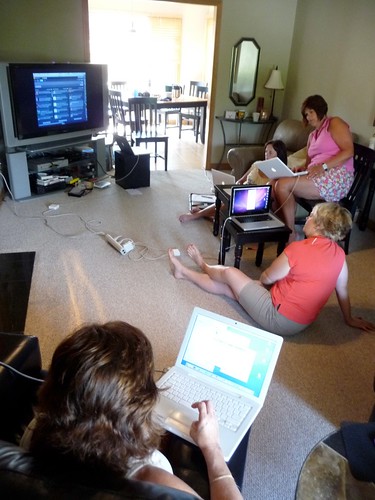
This week, I hosted four colleagues for a full day of hands-on learning intended to help novice geeks to get the most of their Mac computers. Contrary to traditional large group PD, this audience had the luxury of going in any of a number of directions, and could do so at a comfortable pace.

I fielded a number of queries about this informal PD through via Twitter, so here are my top 10 discoveries from a day of learning with friends:

1] You can use a large screen television as a projection device.

2] Although the operating system is simple to navigate, there are simple tricks that you may take for granted that may be greatly valued by your colleagues.

3] Small changes to System Preferences can allow any user to be more productive.

4] Individual needs are much easier to address in a small group meeting than they are in traditional PD. (I.e., A teacher with a new external hard drive invited us to explore how to use Time Machine to backup files.)

5] If you use Skitch, ctrl+shift+5 is the new ctrl+shift+4

6] Teachers can have fun with Skype by contacting folks in the same room; and you can demonstrate the power of this collaborative tool by inviting guest experts to dial in to share their expertise. Thanks @BrendaSherry, @KellyPower & @IainRobertson!

7] Delicious is a great tool to introduce teachers to the power of the hive mind.

8] Engaging in conversation within a PD session is a good thing. How else can folks teach one another and share their giddy love of learning?

9] This type of learning should be taking place on a regular basis. The consensus from participants was that we should schedule follow-up meetings. First on our next agenda: "So, What happened?"

10] Teacher-learners are happy to share food in exchange for tech tips!

Friday, July 30, 2010

The Three 'R's of Educational Leadership

For the fourth time, Scott McLeod is calling on bloggers to help support administrators in becoming effective school technology leaders through Leadership Day.

There are hundreds of things I'd love to share with administrators and classroom leaders, but let me boil it down to 3 R's to replace Readin', Ritin', and 'Rithmatic.

1. Take Risks
There are many things we do in school, for no other reason, than we've always done things a particular way. Consider the use of chalk; the alignment of desks in rows; the use of written tests; or the opening of the school day to fit with bus-schedules instead of the needs of growing brains.

We can continue to do things the way we've always done them, or, we can recognize the folly in some of our practices, and can strive to find better ways. In your own work as an administrator, don't be afraid to take risks and to encourage others to do the same. Two important questions to consider any day; Why? and Why not?

2. Conduct Research

Whether encouraging leaders to pilot new technologies, or asking peers to consider novel practices, work with colleagues to discover the best ways to engage today's learners. Celebrate exemplary achievements, and gather evidence to support the expansion of successful strategies.

The craft of teaching should be one of continual evolution. Through collegial discussion, educators can examine local teaching practices, and with the support of a networked leader, can share their professional learning with a global audience.

3. Build Relationships
You don't have to go it alone. Network with colleagues near and far, to keep abreast of emerging trends. Share your challenges, questions, and ideas, and learn through shared experiences. We may not be with you in person, but we'll have your back should you require resources, ideas, or other forms of support.

In modeling the collaborative skills of a 21st century educator, your experiences are sure to bring a sense of wonder to your professional life. Once you see the potential of networked learning, it will be natural for you to advocate for the modern learning needs of teachers and students alike.

Tuesday, July 27, 2010

The Social Network

'The Social Network' is one of those trailers that seems to work one its own as a short subject movie. At the opening, the words of the choir over the computer screen close-ups are ethereal, intimate, and sad all at the same time.

Do you yearn to fit in? Do you need a digital channel to enhance your sense of belonging? Many of the quotes within this trailer help me to understand how individuals may be inclined to value their online social connections above all else.


While hundreds of millions engage in social experiences through Facebook and other social media channels, I wonder how many will engage in online conversations about this movie, rather than experiencing it first hand with real friends? The film opens in October... How many educators will see it as a piece of media worthy of consideration?


LATE ADDITION

A number of days ago, I came across this explanation of Facebook that might be worth considering as a teaching tool, especially when it comes to privacy settings and terms of use agreements.

A Movie for Anyone On FaceBook from Casey Neistat on Vimeo.

Wednesday, June 16, 2010

Holding Up a Mirror

As the school year winds down, it gives each of us time to pause, and to reflect on what we've accomplished. It's through such critical consideration of our work, that we grow as teachers and as learners, so let's be sure to get beyond ourselves to consider how our actions have led others to grow.

What Students Accomplish
If you attend school at the Science Leadership Academy in Philadelphia, the reflection by your principal, Chris Lehmann, might lead everyone to reflect on what the graduating class has accomplished; not just in one defining year, but in an entire high school career.

If you're Megan Palevich, you lead your students to reflect on what they've accomplished, and you discover, that they've learned much more than the curriculum dictates.


Learning With Colleagues
Do you work within a community of teacher-learners?
How have you acted as a mentor to fellow teachers?
Which discoveries have you shared with your colleagues?
Is the sharing of your personal/professional learning a common practice at your school?

Learning in Community
How have you highlighted student achievement for your community?
Have your parents discovered what learning looks like?
Do folks know why you structure learning the way you do?
Have the doors of your classroom been open to visitors?
How have real people augmented your lessons?
Which learning stories are worth sharing with an even wider audience?
How have you publicly celebrated the greatest achievements and minor miracles from this school year?

What about You?
Sure, you've grown too. You've used proven methods and mixed in the use of some new lessons and tools. But it's in the work of our students and colleagues in the context of a learning community that we can best measure the effectiveness of our work. So before you hold up the mirror to yourself at year's end, hold it up to your fellow learners, including teachers, students and community members, and consider the ripples that have been triggered by your work.


Photo Credit: A6U571N

Monday, June 7, 2010

Cognitive Surplus vs Social Deficit


In recent weeks, I've done less collaborating globally, and more connecting locally; and over that period of time, I've felt less stressed, and more refreshed. While I continue to think, to learn, and to share, I regret that I've occasionally done so at the expense of spending time with those who matter the most to me.

I agree with Shirky's point that we can do plenty of good by applying our spare intellectual time to pursuits of collaborative knowledge development; but I've re-discovered that there is also much to be gained in freeing the mind from such work in order to be fully human.

I've found value in digging in my garden with my spouse; coaching kids soccer with my family; spending time on the links with friends; and reading real paper books and magazines all alone in my hammock. Knowing that these physical, social and emotional investments are paying rich personal dividends, I can't help but wonder: How will you be paying off your social deficit this summer?

Thursday, June 3, 2010

Lessons Learned in Error

Even if you weren't among the 17,738 fans present at last night's Tigers vs Indians baseball game, you have likely heard the ripples of the '28-out perfect game' pitched by Armando Galarraga.

Calls for the resignation or firing of someone relying on their perception of a moment in time, are not warranted. The play was a classic 'bang-bang' play, that in real time would have been a difficult call for any observer. If you had the best seats at Comerica Park, this is how you might have witnessed sports history:


So what's a person to do?
Jim Joyce: When shown in slow-motion or freeze-frame, the 27th out is more obvious. So, after the game, in a move rarely seen among sports officials, first base umpire Jim Joyce chose to apologize in person, to the Detroit Tiger pitcher.

Armando Galarraga: Even as his greatest lifetime sports achievement vaporized, Armando Galarraga kept his aplomb. The disappointed pitcher closed out the game, and later chose to accept Joyce's apology. At today's game, Galarraga was slated to deliver the line-up card to today's home plate umpire, Jim Joyce... I hope they each received a warm ovation.

Bud Selig: As Commissioner of Major League Baseball, Bud Selig has the authority to overturn the ruling on the field, and to award the baseball's 21st perfect game to Galarraga. Whether or not he chooses to do so, the story of this game, and it's aftermath will forever be a part of the history of baseball, a game values tradition above all else.

Whether or not Selig chooses to correct the umpire's error, I think that this sports event can be seen as a win-win-win. Joyce should be appreciated for acknowledging that though humans may err, they can also make amends; Galarraga and his teammates will be recognized for an incredible accomplishment; and the commissioner's office will be remembered either for righting a wrong; or for reminding us that there are many human elements in the American pastime.

So, why aren't you sharing this modern fable with your students? Surely there are lessons in this story worth sharing, aren't there?