Sunday, September 9, 2012

UnPlugd 2012: Assessing the Unmeasurable


This summer, 39 intrepid educators embarked on a journey that brought them from the skyscrapers of downtown Toronto, to the shores of Kawawaymog Lake in the region of Algonquin Park. With the promise of a wide range of engaging experiences, UnPlug’d 2012 brought together co-learners from Australia, USA, and Canada to share stories about what matters most in education and to collaboratively author a collection of letters that will be published later this fall.


When it comes to digesting a good meal, a sense of satiation triggers positive feelings. In a similar way, participants engaged in our unique unplugged learning adventure, left UnPlug’d with a feeling of fullness, refueled by deep conversation, nourished by rich natural meals, and refreshed through recreation amid the splendor of Ontario’s near north. While we can measure the success of our event by pointing to the product that we produced, many of the hidden benefits our event, are intangible and immeasurable.
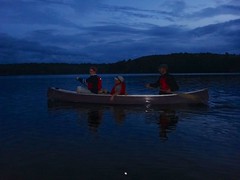
How can you summarize the effectiveness of a collaborative writing venture that brings to life the narrative experiences of a diverse group of co-authors? How can one measure the value of a journey in a private rail car filled with kindred spirits? How do you put a value on the achievement of emboldened colleagues who succeeded in their cross-lake swim to an iconic tree on a nearby island? How might you assess the experience of once distant friends sharing their passion for running by connecting for a morning run amidst the wonder of Algonquin region? How can anyone measure the magic of an evening paddle to a sauna, swim and campfire, when capped by the shooting stars of the Perseid meteor showers? Is it even worth considering what it means to hold in your hands a guitar that is made up of historic artifacts from across Canada or what it feels like to hear that same guitar played at a campfire or at a private indoor gathering?
While educators had to take up the invitation to participate in UnPlug’d 2012, it was through generous sponsorships and donations from a number of Canadian and US EdTech companies, that we were able to set the conditions for a rich and memorable event. We are indebted to many partners who supported our mission to dig into our collective memory, to share experiences with distant colleagues, and to edit and publish our most impassioned ideals.
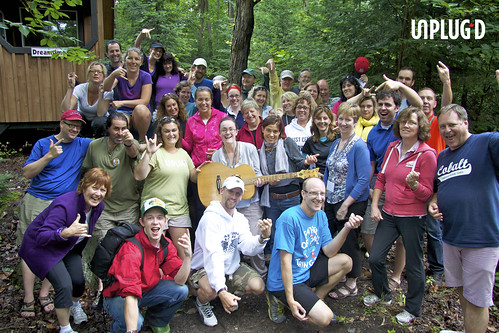
UnPlugd’d participants continue to talk, share, and collaborate by leveraging social media tools, and by gathering for face-to-face meetings and professional development events. Through open conversations on Twitter, and through deeper reflection on personal blogs, participants continue to reflect on their experiences, to consider adaptations to their professional practice, and to lead by learning in public. As our multimedia publications near completion, the dividends from UnPlug’d 2012 are sure to impact connected teacher-learners from Canada and beyond. We invite you to consider coming along for the ride at unplugd.ca.

Image credits: Rodd LucierLisa NealeTodd Lucier
Many more images are available in the UnPlugd12 Photo Pool
This article was originally written to appear in the MindShare Learning Report.

Wednesday, August 15, 2012

UnPacking UnPlugd12

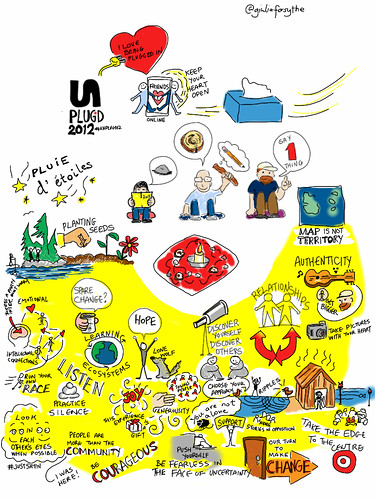
After an amazing time on the Edge of Algonquin Park in Ontario, we've begun to unpack a lot of things... the most important of which, aren't things, but ideas.  The concept map below was drawn by Giulia Forsythe, one of the small group facilitators at this year's event.  The sketch reflects the many takeaways identified by participants at our final large group circle at UnPlugd12.


Incidentally, this is not the only awesome image Giulia has created.  Beyond her unique ability to represent ideas in doodles, she is also an avid photographer. In fact, one of the images she captured from UnPlug'd 2011 was used as the basis of the postcards being shared by this year's participants.  You can imagine my chagrine when I learned that I failed to attribute this photo when creating the postcards.  I'll make it up to you somehow Giulia.  :)


These images and many other wonderful images by Giulia Forsythe are licensed for use through Creative Commons.

Saturday, June 16, 2012

Going Tribal

There was a time not too long ago, when I was lonely in my professional life.  Although I felt that I was doing really good work in the area of gifted education, few of my local colleagues had any idea of the work I was doing.  It was only when I had the opportunity to meet face-to-face with regional gifted education specialists, that I felt connected to a tribe.   Kindred spirits who truly understood what I was going through, began to share resources and strategies and to collaborate in the delivery  of regional events for gifted learners.  

A few years later I found myself in a newly created provincial role, assisting district school boards in leveraging e-learning tools.  My tribe was small, with six widely scattered teachers attempting to do the same work across the province of Ontario.  Our team stayed in touch with weekly meetings that always included a few minutes sharing personal and familial stories.  Although we only met face to face a half dozen times in the two years I was in the role, I continue to feel a deep sense of connection with these colleagues.


One of my local tribe-mates, Jim Pedrech, is a talented teacher who until recently was unaware that he had many peers who were engaged in similar missions, sharing relevant and compelling learning experiences with students.  Today, Jim pointed me to a talk that highlights the value of working and learning with a cadre of compadres.


In this TEDxUSC video, Rodney Mullin tells the story of a skateboarding tribe that builds on the creative work of members in order to ensure the collective moves forward.  In many ways the work of these individuals mirrors the work many of us are engaged in when we share the triumphs and tragedies taking place in our classrooms.  If you can't spare the time for this entire video,
jump to this point... but hear the word 'teachers' when he says the word 'skaters'.


In classrooms all around the world, innovators are doing creative work engaging apt tools to help their students learn relevant skills... and they're doing so alone.  Many have yet to discover who their peers are, let along to connect with them in meaningful ways.  While a wide range of social media tools now allow such teachers to find one another, most have no idea who their tribemates are.  The most lonely, may be those who have discovered true peers in this online world, but who rarely if ever have opportunities to meet face-to-face with their recently discovered colleagues. The lucky few who have intermittent opportunities to engage in conversations and face-to-face meetings, should not take for granted such connective opportunities.

One of my distant colleagues, David Truss has been thinking about the difference between his online self, his real world self.  David's words ring more true for me than they otherwise might, in large part thanks to numerous face-to-face conversations we were able to share at the recent Connected Canada Conference:  "The point is that we are sharing more and more of ourselves online and that ‘person’ that we share online is becoming a bigger & bigger part of who we really are."

I think that the more comfortable we become within a community of online peers, the more we let our true selves leak into the community.  Our voices become more authentic, our lives become more transparent, and our relationships become more meaningful.  
Just as skateboarders push the boundaries of what is possible by sharing within a tight-knit community, once lonely teachers who might otherwise push boundaries in secret, are becoming kindred spirits and members of a growing tribe. 

Sunday, June 10, 2012

140 Voices

The 140 Voices project was co-developed by Rodd Lucier and Zoe Branigan-Pipe, who are working to bring co-learners to life through a collaborative project called 140 Voices.  The 7 Degrees of Connectedness was created in part to help explain the 140 Voices project.  

Why 140 Voices?
It’s the number of seconds that anyone can spare for a quick video.

The number matches the maximum number of characters in a tweet.
Many of the folks who will appear, are actively engaged on Twitter.
How long will it take to engage the voices of 140 educators-leaders-change agents? Here, a short video interview with @Stephen_Hurley explains how the 140 Voices project came about and why we feel it fits so perfectly with the collaborative publishing taking place on VoicEd.ca.


Do you have a story to share? 

Do you know someone else who has a story to tell?While you could wait for us to record you in person or via Skype, with a little video-editing playfulness, you can create your own 140 Voices video. Following the steps below, you can share your own story or any story of interest.


To Capture and Post a Story:

1.  Film yourself or a colleague using any digital video camera or camera-equipped computer. External microphones are helpful, but not necessary.
2.  Answer (or ask) the following questions or respond to the prompts:
* What is your name, role and where are you from (city, organization)?
* What is your current project or initiative?
* How does this project impact student learning? Teacher learning?
* How can folks keep track of your online learning?

3. Upload video content to a video editor of your choice (imovie, youtube editor)
4. Add the 140 Voices intro and extro to your video using the tutorial provided or some other method.
5. Post your video to YouTube using the hashtag #140voices.
To do this part, you will need a Youtube account (or any Google account)

6. Share the link with either @stephen_hurley, @thecleversheep or @zbpipe via Twitter using the hashtag #140voices
7. Videos will be collected and shared at VoicEd.ca
Rodd Lucier explains walks you through these steps in the 140 Voices Video Tutorial.


Peter Skillen and Brenda Sherry, are two dynamic and innovative educators from Ontario.  Their videos are the first of what we hope to be 140 short interviews to be hosted at VoicEd.ca.   

Wednesday, June 6, 2012

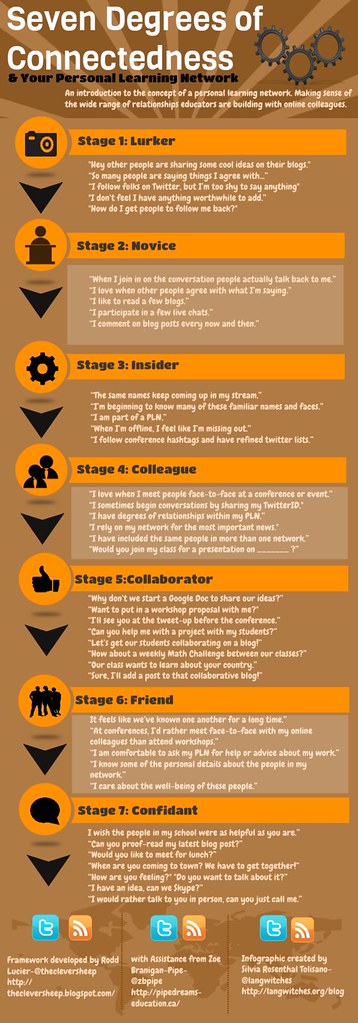
Seven Degrees of Connectedness... the Infographic

While I haven't had time to respond to all the comments I received on the framework I posted yesterday,  I did engage in a short conversation with Sylvia Tolisano about turning the Seven Degrees of Connectness into an infographic.


After following Sylvia's work online for a few years, I count myself lucky for having the opportunity to meet her first hand at Educon 2.3.  After sharing an idea, and engaging in a short conversation, Sylvia produced the infographic that follows.  In my personal learning network, I'm now pleased to count her as a collaborator.  :)  


Tuesday, June 5, 2012

Seven Degrees of Connectedness

What’s the most significant event that causes you to pay closer attention to the learners in your network? For me, it is meeting face-to-face. I’m more attuned to those people in my learning network whose voices are amplified because we met at a conference; exchanged stories; shared a meal. Fleshed out by personality and attitude, I find myself savouring the words and ideas I consume online.

The framework below was developed with the assistance of Zoe Branigan-Pipe, who is helping to bring co-learners to life through a collaborative project called 140 Voices. More will follow on that project, but for now, I’d be interested to know where you see yourself in what I'm calling "The Seven Degrees of Connectedness".

The thing is - I see myself in different stages with different people and groups. I'm wondering, where you see yourself in the different relationships you’ve developed? Each stage of connectedness has impacted my learning in different ways.  Have you had similar experiences?  Explicit actions lead from one stage to another, but maybe the stages are not sequential...


The Seven Degrees of Connectedness

Stage 1: Lurker
“Hey other people are sharing some cool ideas on their blogs.
“So many people are saying things I agree with...”
“I follow folks on Twitter, but I’m too shy to say anything" 
"I don’t feel I have anything worthwhile to add.”
"How do I get people to follow me back?"

Stage 2: Novice
“When I join in on the conversation people actually talk back to me.”
“I love when other people agree with what I’m saying.”
“I like to read a few blogs.”
“I participate in a few live chats.”
“I comment on blog posts every now and then.”
“I love my PLN!”

Stage 3: Insider
“The same names keep coming up in my stream.”
“I’m beginning to know many of these familiar names and faces.”
“I am part of a PLN.”
“When I’m offline, I feel like I’m missing out.”
“I follow conference hashtags and have refined twitter lists.”

Stage 4: Colleague
“I love when I meet people face-to-face at a conference or event.”
“I sometimes begin conversations by sharing my TwitterID."
“I have degrees of relationships within my PLN.”
"I rely on my network for the most important news."
“I have included the same people in more than one network.”
“Would you join my class for a presentation on _______ ?”
Stage 5:
Collaborator
“Why don’t we start a Google Doc to share our ideas?”
“Want to put in a workshop proposal with me?"
“I’ll see you at the tweet-up before the conference.”
“Can you help me with a project with my students?”
“Let’s get our students collaborating on a blog!”
“How about a weekly Math Challenge between our classes?”
“Our class wants to learn about your country.”
“Sure, I’ll add a post to that collaborative blog!”

Stage 6: Friend

“It feels like we’ve known one another for a long time.”
“At conferences, I’d rather meet face-to-face with my online colleagues than attend workshops.”
“I am comfortable to ask my PLN for help or advice about my work.”
“I know some of the personal details about the people in my network.”
“I care about the well-being of these people.”

Stage 7: Confidant

“I wish the people in my school were as helpful as you are.”
“Can you proof-read my latest blog post?”
“Would you like to meet for lunch?”
“When are you coming to town? We have to get together!”
“How are you feeling?" "Do you want to talk about it?”
“I have an idea, can we Skype?”
“I would rather talk to you in person, can you just call me.”


Is a framework like this worth discussing, or refining.  Can it serve as an introduction to the concept of a personal learning network?  Does it help you make sense of the wide range of relationships you've been building with online colleagues?  I'd love to know your thoughts...


Image Credit: Seven by Losmininos