
Showing posts with label networks. Show all posts

Monday, October 13, 2008

CCK08: 'Group' Semantics

Groups emphasize sameness;
Networks emphasize diversity;

Groups emphasize order and control;
Networks emphasize autonomy;

Groups emphasize borders and membership;
Networks emphasize openness;

Groups emphasize additive, cumulative knowledge;
Networks emphasize emergent knowledge.
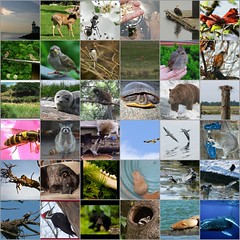

In reaching consensus around the connectivist definitions of these terms, I find myself wishing that we had more examples of networking in nature. Even so, the animal kingdom offers us many parallel words that can be translated into characteristics of 'groups':

School (fish): Whether fish or students, most schools consist of cohorts or classes who are destined to swim in unision... rogue fish or learners are less likely to thrive or survive in such an environment.

Hive (bees): Look for evidence of abundant activity, all for a common purpose.

Herd (caribou): A group driven to act in a common way for the benefit of the entire group.

Cast (crabs): When a collective takes on a large production, the organized group can achieve maximal benefits by having individual members specialize in the completion of distinct tasks.

Team (cattle): A group that works collaboratively to achieve a common goal will sometimes have members take on common roles, but might also assign distinct responsibilities based on individual expertise.

Gang (elk): Coming together intermittently, this is a disorganized group that acts reactively without need for a pre-determined purpose.

Pack (rats): Rather than acting constructively, this group attempts to 'bring down' others, rather than to contribute for the benefit of the group.

Mob (kangaroos): At times, a large group that is not formally organized, will coalesce in response to a specific catalyst.

Flock (gulls): Just as the movement in the stars/seasons caused a group of birds to migrate together, so too are distributed members of a group sometimes influenced by memes.

Huddle (penguins): This group would rather find answers from its own members rather than seek assistance or expertise from the outside.

Posse (turkeys): A group whose members have forged lasting connections over a period of time, gathers on an ad hoc basis as needs arise. Such groups are able to respond more quickly than many other groups, thanks in part to pre-existing familiarity among members.

Crowd (porpoises): A group that finds itself wanting to act after participating in a common experience such as a symposium, workshop, or presentation.

Pod (seals): Although the benefits to all members of the group are very similar, membership in a pod might be seen as more flexible, allowing an individual to be a member of more than one group.

Although I've discovered many examples of groups harnessing sameness and order to achieve collective benefits, similar parallels to the openness and autonomy of a network are more challenging to isolate. Maybe 'networking' is new to the animal kingdom; or perhaps such behaviors are learned and are indicative of higher level thinking?

I like to think that my online persona "The Clever Sheep" is an apt metaphor for the networked learner. I prefer to follow my own path, while leading others in new directions; to harness the expertise of my online peers, while contributing to the professional learning of like-minded colleagues.


Photo Credit: Yeimaya

Wednesday, January 16, 2008

NOT Social Networks but Learning Networks

The phenomenon that is 'social networking', is not what forward thinking educators are doing. Most young people using My Space, Twitter, and Facebook are doing so only to continue conversations held in the real world. Many of the wall-postings and text messages that form the backbone of social networks, are simply attempts to see what people are up to 'socially' rather than to engage in conversations that lead to knowledge creation.

Teacher 2.0 on the other hand, is beginning to create networks of like-minded educators intent upon learning from one another. These 'learning networks' consist similarly of information exchanges, with at least one major exception: these networks are sharing information on a range of topics of definable topics of interest to the collective.

If indeed the issue of our use of social tools is as important as Will Richardson suggests , then we need to do a better job of describing what we do! It's possible that an appropriate moniker might address some of the issues highlighted by Danah Boyd in 'The Economist' debate.

What shall we call it?

There are a number of related terms that would be more appropriate than 'social networks' to describe this type of collaborative learning: 'social learning’; or ‘learning networks’; or even ’social learning networks’, would be more appropriate terms. Any which way you slice it, the term 'learning', is conspicuous by its absence when one is describing the phenomenonal sharing taking place via blogs, wikis, tweets and other read/write tools.

Is it even new?

Building social learning networks is something many educators have done for years via email/webpal programs. (I remember doing such a program working with ten classrooms scattered across North America via a 1200 baud modem via AT&T around 1990.) The difference is that we now have access to tools that give us instant access not only to text, but to video and audio as well.

It’s too easy in using the term ’social networking’, to focus on the everyday social communication that young people participate in via Web 2.0 tools. Absent a true learning purpose, such communications are simply social dialogue. Learning networks are different, let's begin highlighting the uniqueness of our dialogue by including, even highlighting, the word learning.

Friday, December 14, 2007

Networks over Nodes


A few hours with Will Richardson spread over the past few days in London, helped me feel for the first time in a long while that "I'm not alone!"

In my work as an e-learning teacher and consultant, I was already aware of del.icio.us, Twitter, WetPaint, blogs, wikis and the many GoogleTools we tabbed through to consider the salient points of building networks; New to me was the fact that these many tools could be networked themselves, drawing upon common content courtesy of RSS.

Even so, what stood out most powerfully for me, was the fact that so many present in the room had so few questions about the relevance of what we were doing. Even Will's 'wait time' failed to illicit many questons or comments, due in large part to the fact that so many of us were on the same wavelength. I was physically immersed in a community who not only 'got it', but seemed to agree that we had to do what we could to connect with one another, and to bring others along for the ride in harnessing the tools.

Will's blog post of today put it very well I think:

It’s different now, somehow, than it was a year ago. It’s more immersive. It all feels deeper, closer somehow. Even more important. Maybe it’s just the glow of the prospect of being home for a month. Or the buzz of spending a couple of days with some folks who seemed to, on some level, get the fact that this really is about more than learning the tools. It’s about creating connections, intellectual connections, for sure, but potentially more.

In a year that I've traveled a fair bit in promoting e-learning across southern Ontario, I appreciated the fact you took leave of those closest to you, to assist others in strengthening their own professional and personal networks. You may not have been the first to state that "The network is more powerful than the node." but you were the first in a long while to engage this learner in high level thinking about the collaborative use of the read-write web!