Wednesday, September 29, 2010

Redefining the 21st Century Learner

Earlier today, I was asked to demonstrate my understanding of the term '21st Century Learner'. I was pleasantly surprised by the question and found myself mentally reviewing a few of the conversations I'd had with colleagues in recent days.

The term may have been adopted to spur educators to consider the relevance of learning experiences being offered to students; to embrace emerging tools in the classroom; and to inspire an evolution in our practice. Now that it's 2010, and we're well into the new millennium, my observations are that the term has failed to engage a majority of educators in critical reflection of their own teaching practice.

By the time I was finished critiquing the term, I was faced with a follow-up question: What term would you use in place of 21st Century Learner?

In considering a more apt term to represent today's school-aged learners, I put forth the term 'refugees'. I went on to explain that I see students every day, who have to unplug, disconnect, and go solo in a world whose terrain is foreign to the way they regularly interact. Rather than interact via mobile devices tethered by invisible signals, most of today's students have to wait for teacher permission to communicate, and even then, can only network with students in the same room. In many ways, it's like being forced to speak a unique language while being contained in a foreign land. What they wouldn't give, to have the freedom to return to their 'home country'!

How would you have responded?

Have you grown tired of the term 21st Century Learner?
Do terms like Digital Native and Digital Immigrant now strike you as failed attempts to categorize youth and their not-quite-so-techy parents and teachers?
Do you have an apt metaphor for today's learners in today's schools?
Do you see today's learners as 'Time Travelers', 'LOST passengers', 'bats without radar', or something different?

The audio version of this story is available as today's episode on The Clever Sheep Podcast.

Image Credit: Alex Mickla

Tuesday, September 21, 2010

Ontario Teachers are Learners

I've often said that I love living in the world of Edu-Blogs and Twitter for the simple reason that this is where the learners are. It's next to impossible to see yourself as a learner, if you're not finding ways to connect with other like-minded educators, so the increasing numbers of Ontario educators learning in virtual spaces has been reassuring.

The act of connecting with virtual colleagues may be rich for each participating individual, but will such engagement ever be enough to bring about systemic change? If inspirational educators worry only about "today, in my classroom", then who will inspire the professional growth local 'unplugged' peers? It begs the question: "Is your PLN virtual, or real?"

In recent years, school-based teams in Ontario have become engaged in Teaching-Learning Critical Pathways a collaborative process that engages teachers in reflective practice. The process has grown out of Crevola, Fullan & Hill's, 2006 book, Breakthrough, and succeeds when every classroom participant benefits from a customized learning experience.

Classroom teachers are active learners throughout the process: collaboratively designing lessons; assessing the effectiveness of shared strategies; using the evidence to plan a way forward. In short, the teachers are co-learners with their charges. Combine this colleague-to-colleague professional learning with what appears to be happening in online spaces, and the future looks promising for Ontario families.

A Caveat:
Boards of education across the province have widely adopted this practice with elementary school teams, yet the TLCP process and related terminology are foreign to secondary teachers in my region. While the Literacy and Numeracy Secretariat has been spearheading the adoption of research-based practices in grades 1 to 8, many secondary schools continue to stagnate.

What are the steps will lead to the development of relevant courses, learning strategies, and professional learning for Ontario's high school teachers?

Photo Credits: story photos courtesy of torres21

Tuesday, September 7, 2010

The Rise of 'Interest-based' Learning

It's been two years since I first wrote about 'Learning Without Teachers', and now Sugata Mitra is sharing compelling stories involving peer instruction, that should lead educators at all levels to re-think what it means to teach.

Mitra's most recent research seems to validate an approach that forgoes 1:1 computing, in favour of a strategy that limits access to learning tools. In a wide range of settings, with diverse populations of learners, Mitra has married the use of communications technology to 'interest-based' learning, and the early results have been stunning, even if counterintuitive.


Do you believe that this 'peer to peer' approach affirms recent developments in professional learning? Does it validate project-based approaches to learning? Might it support equipping a classroom with an On Demand Ecosystem?

Sugata Mitra speculates that "Education is a self organising system, where learning is an emergent phenomenon..." and he is committed to researching this contention. Whether or not we agree, Mitra's work provides an unspoken challenge: How do you assess the effectiveness of the tools and learning strategies that you employ?

Saturday, August 7, 2010

Hidden Treasures

Remember the good old days when folks used to play outside?
Geocaching is a wonderful way to remind yourself and friends and family that we're surrounded by wonderful natural places ripe for exploring. If you have access to a GPS device, you can use longitude and latitude coordinates and secret clues to locate 'hidden treasures'.


Yesterday, we used Geocaching Toolkit and an iPhone to lead us to cache locations near Springbank Park in London, Ontario. While we've gone hiking and geocaching before, I was lucky enough to capture the moments that followed my son's first geocaching 'find'.

Tuesday, August 3, 2010

Mac Mini-camp

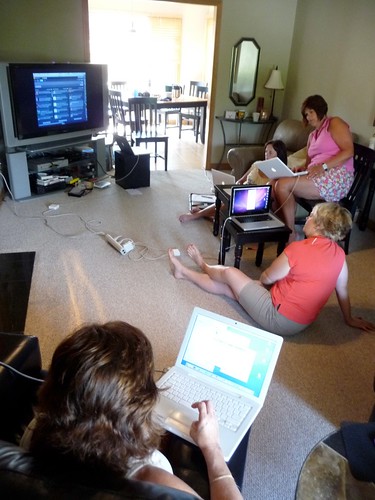
This week, I hosted four colleagues for a full day of hands-on learning intended to help novice geeks to get the most of their Mac computers. Contrary to traditional large group PD, this audience had the luxury of going in any of a number of directions, and could do so at a comfortable pace.

I fielded a number of queries about this informal PD through via Twitter, so here are my top 10 discoveries from a day of learning with friends:

1] You can use a large screen television as a projection device.

2] Although the operating system is simple to navigate, there are simple tricks that you may take for granted that may be greatly valued by your colleagues.

3] Small changes to System Preferences can allow any user to be more productive.

4] Individual needs are much easier to address in a small group meeting than they are in traditional PD. (I.e., A teacher with a new external hard drive invited us to explore how to use Time Machine to backup files.)

5] If you use Skitch, ctrl+shift+5 is the new ctrl+shift+4

6] Teachers can have fun with Skype by contacting folks in the same room; and you can demonstrate the power of this collaborative tool by inviting guest experts to dial in to share their expertise. Thanks @BrendaSherry, @KellyPower & @IainRobertson!

7] Delicious is a great tool to introduce teachers to the power of the hive mind.

8] Engaging in conversation within a PD session is a good thing. How else can folks teach one another and share their giddy love of learning?

9] This type of learning should be taking place on a regular basis. The consensus from participants was that we should schedule follow-up meetings. First on our next agenda: "So, What happened?"

10] Teacher-learners are happy to share food in exchange for tech tips!

Friday, July 30, 2010

The Three 'R's of Educational Leadership

For the fourth time, Scott McLeod is calling on bloggers to help support administrators in becoming effective school technology leaders through Leadership Day.

There are hundreds of things I'd love to share with administrators and classroom leaders, but let me boil it down to 3 R's to replace Readin', Ritin', and 'Rithmatic.

1. Take Risks
There are many things we do in school, for no other reason, than we've always done things a particular way. Consider the use of chalk; the alignment of desks in rows; the use of written tests; or the opening of the school day to fit with bus-schedules instead of the needs of growing brains.

We can continue to do things the way we've always done them, or, we can recognize the folly in some of our practices, and can strive to find better ways. In your own work as an administrator, don't be afraid to take risks and to encourage others to do the same. Two important questions to consider any day; Why? and Why not?

2. Conduct Research

Whether encouraging leaders to pilot new technologies, or asking peers to consider novel practices, work with colleagues to discover the best ways to engage today's learners. Celebrate exemplary achievements, and gather evidence to support the expansion of successful strategies.

The craft of teaching should be one of continual evolution. Through collegial discussion, educators can examine local teaching practices, and with the support of a networked leader, can share their professional learning with a global audience.

3. Build Relationships
You don't have to go it alone. Network with colleagues near and far, to keep abreast of emerging trends. Share your challenges, questions, and ideas, and learn through shared experiences. We may not be with you in person, but we'll have your back should you require resources, ideas, or other forms of support.

In modeling the collaborative skills of a 21st century educator, your experiences are sure to bring a sense of wonder to your professional life. Once you see the potential of networked learning, it will be natural for you to advocate for the modern learning needs of teachers and students alike.