Showing posts with label computer. Show all posts

Tuesday, July 15, 2008

iPhone as Little Brother!


A funny thing happened to me at the little Rogers store at the mall yesterday... Empty store: iPhones in stock: Couldn't resist!

After spending 24 hours with this iconic tool, early indications are that I will be doing more mobile computing and less desktop computing in the coming year. So far, I've been impressed with the way the iphone integrates existing social networks and the embedded camera to allow anyone to play the part of 'Little Brother'. If you have an iPhone and either Twitterrific or Twittelator you can access Twitpic or AP's Mobile News Network to report on moment to moment goings on.

While you can burn your 3G airtime being mobile, the iPhone is able to access any open wireless network in order to browse the web and upload/download content. Additionally, the iTunes App Store provides access to free and low cost tools that will one day allow this communications device to do just about anything a computer can do.

Still in it's relative infancy, this powerful network-friendly computer will one day yield great influence on education. Communications technologies, organizational applications, web browsers, and networking tools, provide promise far beyond simple access to the world wide web. The iPhone and it's digital cousins, herald the potential of 1:1 computing, just as generations of educators begin to harness the read/write web.

More early reflections are available on today's Teacher 2.0 podcast.

Monday, March 17, 2008

I Think I'm Addicted!

Can it be? Is my attraction to learning via the Web, truly an addiction?

"Like other addicts, users experience cravings, urges, withdrawal and tolerance, requiring more and better equipment and software, or more and more hours online, according to Dr. Jerald Block, a psychiatrist at the Oregon Health and Science University in Portland. Block says people can lose all track of time or neglect "basic drives," like eating or sleeping."


According to an article in today's Windsor Star, compulsive emailing and text-messaging may soon be classified as an illness. Although the Diagnostic and Statistical Manual (DSM-V) is not due for revision for a few years, I think my own desire for online interaction has many of the same the hallmarks of obsessive compulsive disorder.

While I suspect many of my colleagues and friends may have already reached this conclusion about my desire to make authentic connections in the virtual world, knowledge of the addictive nature of today's modes of communication, may be something worth discussing with students. Maybe that glaze in the eyes of teens and tweens at 8 a.m. has less to do with lack of sleep, and more to do with withdrawal from their evening 'habits'?

Late addition 1: My addiction led me to discover a really cool innovation... find out more on today's Teacher 2.0 Podcast.

Late addition 2: Will Richardson has found a book that makes my addiction sound more palatable... Maybe I'm just an 'infovore'.

Photo Credit: Tim O'Bryan

Thursday, March 13, 2008

What's Good for the Kids...

A study of grade 7 students in Montreal shows too many are spending too much time in front of 'screens'. According to the report as published in the London Free Press:

"The bulk of the kids studied -- about 60 per cent -- spent an average of 20 hours a week in front of a screen, whether that was to watch TV, play a video game or navigate the Internet for recreational purposes.

But about a third spend closer to 40 hours a week in front of a screen. And between seven and 10 per cent of the teenagers logged 50 or more hours a week of screen time, researchers found."


Has anyone ever conducted a similar study on adults? In my own daily work, I necessarily spend many hours a week in front of a computer screen... maybe I should track this time?

If such 'activity' is related to a sedentary lifestyle, leading to heart disease and obesity, maybe we should concern ourselves with the state of the nation rather than the state of teens? In a world where a 35 year old woman can spend two years on a toilet seat...

A late breaking anecdote to consider: At today's synchronized swimming competition, I thought a dad had found a novel place to catch up on office work. After discovering a power outlet in the spectator area, he had plugged in his notebook computer... to play solitaire! Yikes. Ever thought of bringing a deck of cards? Maybe we really do need to take inventory of 'screen time' by adults!

Photo Credit: Tom: An Untrained Eye

Saturday, March 8, 2008

Expelled for 'Studying' on Facebook

First year computer engineering student Chris Avenir is facing expulsion after a teacher at Ryerson University discovered a Facebook group set up to share tips and answers to an online testing system.

Will this action result in a culture of fear among students who participate in study groups online?

I agree with Jesse Hirsh who is quoted in on online Canwest article:

"The online culture is outpacing the curriculum and education system," said Jesse Hirsh, who has been studying social websites for more than a decade. "These students are being smart and using the Internet the way that it should be used. This is the future of education."


I find it ironic that The student is studying 'Computer Engineering" and the administration at Ryerson is upset that he and well over 100 of his classmates are leveraging technology to share strategies on beating the technology-based assessment system used at the Toronto school.

In stark contrast to traditional testing and exams, "Studio Learning" first caught my attention in November of 2004, when I read an article on 'New Jersey Institute Of Technology Pioneers New Way To Teach Engineers'. At the time, I was surprised that tens of thousands of dollars were being granted to a 'novel teaching method' that I'd been employing with elementary students for years! Read bioengineering associate professor Richard Foulds' take on the effectiveness of his approach.

Rather than come down on students who have designed creative solutions to 'beat the system'... It's time that universities join others in developing rich assessment opportunities that engage students in solving authentic problems.

Photo Credit: Grant Hutchinson
Teacher 2.0 Pocast: Cheating on Facebook

Friday, March 7, 2008

Naming the Machine

After spending a week or so considering what how consciousness might effect our World Wide Machine, it's time to consider at least one more critical question:

What should we name this global machine?

Would you reuse a common digital name like "Interac" or "Flickr"? Do you fancy human type names like "Johnny 5" or "HAL"? Or, should we revisit Acronym names likes like "ENIAC" or the "WOPR"?
Rather than go with a male or female name, I'd like to suggest we name our global machine: "the Machine".

The name "Machine" is consistent with a few of my favourite intelligent machines. It would fit with the way the Robinson family from Lost in Space, had a robot named "Robot"; and the way the original Star Trek crew relied on a computer named "Computer". Not only that, it would be easy to remember!

Although I do like my idea, we're all technically the parents and teachers of this machine, so maybe we'd better make a collaborative decision? So global interconnected human-folk, what do you think? Feel free to leave your suggestion as a comment below...

Don't hesitate! If we don't get on this before too long, the Machine might decide to name itself as some unpronounceable symbol!

Photo credit: Scotto Bear
One final podcast on this topic: The Teacher 2.0 Podcast

Thursday, March 6, 2008

Teaching the Machine: Part V

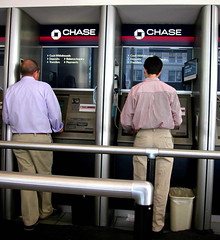
You've got to watch out for those instant teller machines... They may know a bit too much!

Did you ever stop to consider what the computers would know about our personal spending lives if they were to get their networked brains together? Our spending patterns, our passwords, our digital signatures are all known to the microchips in these vastly interconnected computers. Although I doubt the hardware would be at all interested in spending my money, maybe the Machine would like to arrange for the transfer of funds to cover that money I was promised from that African prince via email...

Rather, I think that the artificially intelligent Machine would have a greater sense of equity than that. I suspect that the Machine's desire for balance and harmony, in place of inequity and chaos, might actually allow the heart of the Machine to strive to correct the inherent imbalance seen in global markets. A networked machine would surely refuse to allow parts of itself to suffer malnourishment, be it technological, intellectual, or otherwise. Would such a machine be more humane than humans? Maybe we should be the first to consider allocating global resources more equitably?

While we don't know what will happen if/when the Machine begins to act on its own, there are two sides of the coin worth considering:

The Good News: the Machine will have been programmed by hundreds of millions of programmers including you and I;

The Bad News
: See above!

Photo Credit: Gerard Van der Leun