Monday, April 7, 2008

Audacity... Free and Simple Audio Recording

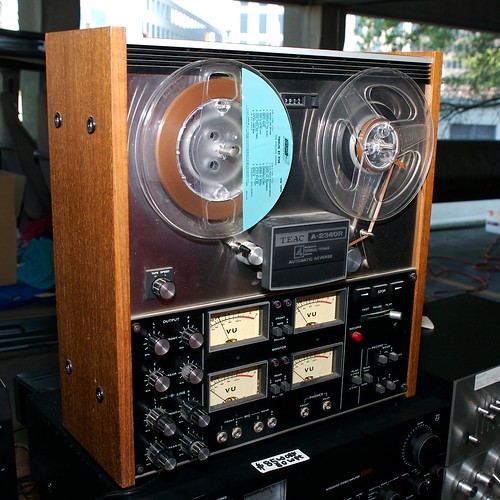
My introduction to audio recording, came when I was in 9 years old and attended school on a 'snow day'. The teachers wanted to keep me occupied, and they turned me loose with a reel-to-reel audio recorder. It seemed like magic that I could make my grade four voice sound like chipmunks or giants by simply playing with the tape speed. Although that event took place for me some 35 years ago, the experience is still vibrant in my mind.

Will your students have similar memories? Today's tools are far more powerful, inexpensive and easy to use, yet most 9 year olds rarely get the chance to do creative work with audio. This post is intended to provide support to those who may be willing to take a creative leap with their students.

There are plenty of professional style audio tools you could use, and while I love to use Garageband, I realize that most educators need a simple, free solution. You may be interested to know that free software is available that you and your students can use to create MP3 audio files! Audacity is an easy-to-use tool that is easily mastered... if you can get past the installation!

Here is how get the software:


If this software is not available on your school network, I recommend sending a polite request to your I-T department. It's difficult to argue with free and easy, especially when such tools open the door for all sorts of creative output by students. Limited options include:

1] create book reviews on audio that can be stored in the library;
2] narrate primary picture books that can be borrowed along with the book by primary students;
3] record old-time radio dramas complete with authentic sound effects;
4] in lieu of public speaking, create audio editorials;
5] broadcast 'rich' school announcements to publicize special events;
6] produce your own original music;
7] challenge students to be foley artists for a given piece of silent video;
8] dramatize poetry or other creative writing...

Beyond sharing audio to live local audiences, MP3 files are easliy shared, and can be published online with little effort. In order to get there, you'll have to take the leap and grab a microphone! If you get any cool projects done, feel free to share your results; I'll be happy to give you or your students airtime on the Teacher 2.0 podcast.

Go for it! Your students will love it, and you'll be meeting multiple curriculum expectations to boot!

Photo credit: Andy Ihnatko

Sunday, April 6, 2008

Diigo is more Filling than Delicious

Social bookmarking favourite Del.icio.us is finally getting strong competition from Diigo, as the edu-blogosphere turns its attention to the 'newer' kid on the block.

Never heard of Diigo?


Diigo is great for highlighting content on pages and for creating and sharing 'notes' on a given web page. For research, or collaborative information gathering and annotation, the highlight features are promising. The fact that you can search for notes recorded by others, and that you can share 'highlights' may take collaborative learning to a new level; but in reflecting on my 'hardcover' past, I've found that the one with the highlighter often brightens information that I'd rather skim past!

I suspect that librarians would be eager to share Diigo to students, if for no other reason than to teach the effective annotation of web resources. Educators looking to combat plagiarism might even call for students to share their web research by requiring the tagging, highlighting and annotating of sources with this tool. Advanced users will make use of the embedded 'webslide' tool, to include their research in automated slideshows.


It remains to be seen whether or not Diigo will make advances on the traction its gained of late, but this beta tool is so feature-rich that many educators are sure to become active 'diigers'. The fact that the site embeds a number of social networking tools (i.e., comment wall; friends' activities; groups...) will likely work against this tool's use within elementary and secondary schools, as filters work overtime to block such interactivity.

Will scholarly university students move to this space to avoid the distractions running amock in Facebook?


For links that you want to find and share easily, Delicious is the most accessible and efficient tool: bookmarking with tags takes only a moment, and the interface is uncomplicated. For higher-level thinking and public reflection about web content including the sharing of more complete meta-information - Diigo may well be the ticket!

The genesis of this topic is explained on today's Teacher 2.0 Podcast... 9 minutes of inspiration.

Friday, April 4, 2008

Motivation through 'Discipline'?!

When did learning stop being engaging?

Learning has always been engaging; School on the other hand...

Does this New York Times article really need a response?

Thursday, April 3, 2008

First Five... or Six!

Fridays were made for Five... or six!

I was first introduced to Merlin Mann's hobby site '5ives' a few years ago, and any time I've visited the site, I've clicked back to reality with a smile on my face. The 'mann' behind 'Inbox Zero' and '43 Folders' regularly lets the right side of his brain take over, and I thought I'd begin launching a new habit... short lists.

This Friday: Six Signs of Spring in Spectator Sports (Why six? Alliteration!)

1] Master's television commercials lead me to take the head covers off of my clubs to see if they're clean

2] The boys of summer bring unbridled hope to major league cities across North America. My rumpled Detroit Tigers cap comes out of the closet.

3] In the National Hockey League, the top teams get ready to grow their playoff beards, while those missing the playoffs get ready for golf;

4] The NCAA Mens Basketball tournament takes centre stage as amateurs play for that 'one shining moment'. It doesn't matter that my brackets are in shambles, there is always a Cinderella to root for.

5] The Olympic torch relay ignites passion about far more than sport!

6] "Gentlemen, Start your engines!" at the Daytona 500. It has to be spring somewhere in February!

What are your signs of spring in spectator sports?

Photo Credits: Andy Simonds; TequilaMike

Wednesday, April 2, 2008

Cheating the Test

How rapidly can a topic of discussion take over the consciousness of the Blogosphere!

Tony Vincent at Learning in Hand may have started it by gathering YouTube 'How-to-Cheat' videos. But it didn't take long for edu-bloggers with huge audiences to follow suit.

Steve Dembo at Teach 42 joined the discussion:

"On a typical test, in a typical classroom, does anybody reading this honestly think they can prevent a highly determined student from cheating?"


And when Will Richardson at Weblogg-ed joined the discussion, he did so with a 'twitteresque' title: "When Are We Going to Stop Giving Kids Tests That They Can Cheat On?" and without contributing content, left the commentary to his network. Tongue-in-cheek I'm wondering: "Is this way of engaging teacher-learners to write your blog 'cheating'?" Like Pooh Bear to Hunny, educators are chiming in... 30+ comments in only 6 hours!

For the record, this topic is near and dear to my heart as someone working to assist teachers in leveraging e-learning solutions. With online courses now being shared province-wide, the customization of tests and assignments is necessary in order to validly assess the learning of online students.

"What types of tests are relevant?

If a test is going to be similar to a real world experience, then the most relevant test should have the following characteristics:

1] The test should allow students access to any information system available (the Internet; Wikipedia; news sources; personal networks…).

2] The test should demand that students ‘apply information’ to a context or situation, rather than simply restate ‘learned’ facts.

3] The test should offer students a range of ways to respond (the written word; audio recording; product dev’t; physical demonstration…).


A ‘test’ of this type is more likely a ‘performance task’; and although this type of test wouldn’t be easy to administer, it would provide the truest test of one’s learning. Thank goodness we don’t provide driver’s licenses, pilot’s licenses, or dental licenses on the basis of the written test!"


Photo Credit: dcJohn

Massive Multiplayer e-Learning

At lunchtime yesterday, I had the opportunity to meet with Peter Purgathofer from the Informatics Faculty at the Institute of Design and Assessment of Technology in Vienna Austria. After some evening editing, I pared our conversation down to this 22 minute 'lesson' on Slidecasting 2.0, an interactive technology in its infancy, that encourages lecture audiences to be active learners, by engaging attaching comments, links, references, and questions to the presenter's slides. The resulting 'rich notes' are then available online for further editing and sharing. If this open source project goes global, PowerPoint lectures may soon be recognized as interactive events!


Peter is truly an engaging teacher, and this while this video is narrow in scope, it was my great pleasure to participate in a conversation with such an enthusiastic teacher-learner. I've included an additional snippet of our conversation on the most recent Teacher 2.0 podcast.